
As easily predicted, declining measles vaccine rates in the US is leading directly to surging measles cases. In 2025 we saw the highest measles cases, 2288, since 1991, and in 2026 we are on track to exceed this number with 1814 confirmed cases so far (these are confirmed cases).
The US is also not getting the worst of it, that would be Bangladesh. The WHO reports: “A total of 19,161 suspected measles cases and 2,897 laboratory-confirmed measles cases have been reported between 15 March and 14 April 2026, including 166 measles-related deaths (CFR 0.9%). The majority (79%) of the reported cases are children aged under 5 years.” This includes 166 deaths, mostly of children under 2.
There is no mystery as to why this is happening. In Bangladesh 74% of the cases are in individuals who are unvaccinated, with another 14% in those who received only one of the two recommended MMR doses. The other 14% were in the fully vaccinated. In the US the numbers are even more stark – with 92% of cases in the unvaccinated and only 4% of cases in the fully vaccinated. These numbers are even more significant when you consider that the fully vaccinated outnumber the unvaccinated by 23 to 1, which translates to the unvaccinated being 264 times more likely to get infected. The difference between the US and Bangladesh is likely due to increased susceptibility in the population due largely to poor nutrition.
We can also look at the numbers over time. Bangladesh was actually approaching elimination of measles up until 2016. Elimination means that a disease is no longer self-sustaining in a population. Eradication means that an infection is removed from the world. Before Bangladesh achieved elimination status, however, vaccine rates declined due to a number of reasons. As vaccine rates droped, measles cases increased, leading to the recent outbreak.
In the US we had achieved elimination status in 2000 (which requires 12 months of no domestic transmission). This correlated directly with the introduction of the measles vaccine in 1963, followed by the combined MMR in 1971, and the recommended second dose of MMR in 1989. In every country, there is a direct correlation between measles vaccine uptake and reduction in cases. In the US, through the early 2000s, we saw fewer than 70 cases per year, all introduced by foreign travel.
The anti-vaccine movement, however, was on the rise at this time, leading to a softening of MMR uptake. It is estimated that 95% average vaccine uptake is required to achieve herd immunity (or community immunity), a condition in which the virus cannot find enough susceptible hosts to spread, and so any outbreaks burn out. Dipping below 95% coverage, even in some regions, leads to increased risk of outbreaks and larger outbreaks. This too we see over and over with undervaccinated populations being the centers for outbreaks.
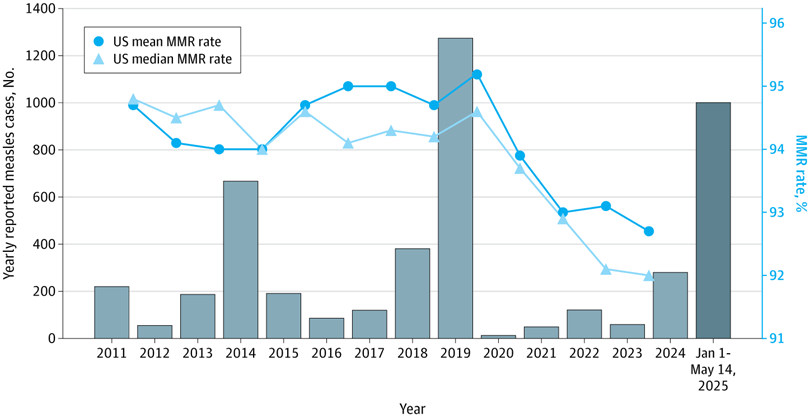
The recent problems with measles began in 2019 with the COVID pandemic. Without relitigating the ultimate causes, it’s pretty clear that COVID led to increased vaccine hesitancy and resistance to public health measures, leading to a further drop in MMR uptake. As you can easily see in the graph above, as vaccine uptake declined, measles cases increased. The US almost lost its elimination status (which requires 12 months of continued internal spread) last year, and very likely might lose it this year. This completes the circle of evidence – as vaccine rates increase measles drops, and as vaccine rates decline measles surges – in every country, over and over. Evidence for the effectiveness and necessity of the MMR vaccine is overwhelming.
The reasons for declining uptake in the US are complex. I am not going to pretend this is all due directly to RFK Jr. The backlash to public health due to COVID clearly seems to be a major trigger. But RFK Jr. is exacerbating the problem. He has a career spreading anti-vaccine misinformation and conspiracy theories. He has decimated the CDC, purged the vaccine council of legitimate scientists and packed it with anti-vaccine cranks, and has done everything possible to undermine vaccine science and confidence in health institutions.
The Trump administration, in general, has been hostile to science and science-based policy. Most recently he has fired all 22 members of the National Science Board, the group that oversees the National Science Foundation. There does not appear to be any legitimate cause for this mass firing, and we can only speculate how they may have displeased the president. Regardless, the bigger picture is that this represents a continued attack on the independence of experts who are supposed to inform federal policy. Purging independent recognized experts and replacing them with ideologues and toadies is a clear authoritarian move, and it is antithetical to science and good governance. This is not normal – these are not political positions we expect to change with every administration.
A surge in measles cases is only the most immediate and obvious result of this anti-science and anti-expertise agenda. Long-term generational damage is guaranteed at this point, and we will likely never know its full extent.