


Well, the time slips away
Leaves you with nothing, mister, but boring stories ofGlory days
Yeah, they’ll pass you by,
Glory days
In the wink of a young girl’s eye
Glory days. glory daysFrom: “Glory Days” by Bruce Springsteen
I’m not a huge Bruce Springsteen fan, although I do like a decent amount of his music. Back when I was in college, Bruce Springsteen’s Born in the U.S.A. became huge, so huge that you just couldn’t escape it anywhere. With the fragmentation of media since the rise of the Internet and streaming, I realize that anyone under around 25-30 (and maybe even older) will likely find it very difficult to understand just how one album could be so ubiquitous and dominate pop culture for months on end, as hit after hit rolled off the album—Fleetwood Mac’s 1977 album Rumours, anyone?—but that’s the way it was in the 1970s and 1980s. Moreover, the year this album came out (1984) was a huge year for music, with Michael Jackson’s Thriller having dominated the charts for the entire preceding year and even into 1984. Now, this little bit of nostalgia isn’t just a 60+-year-old guy looking back at his college days in the 1980s and missing his youth; I bring this up for a very specific reason, namely because the other day I heard a song from Born in the U.S.A. that seemed very relevant to something that I noticed last week, and, yes, the song is Glory Days.
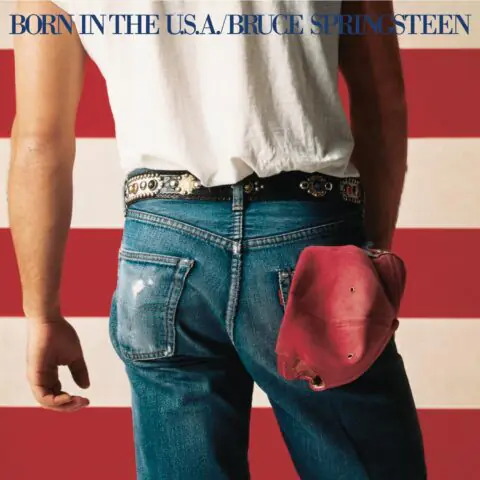
Glory Days is a song about thirty-something people obsessively reminiscing about their high school days, which for them were their glory days. It starts out with a mention of a man who was a great pitcher in high school—a pitcher who “could throw that speedball by you” to “make you look like a fool”—and that’s all he can talk about when the singer meets him in a bar for a couple of drinks. Then we meet a woman who in high school was the girl who “could turn all the boys’ heads” but now is a divorced mother of two whom the singer occasionally visits on Friday nights after she’s put the kids to bed. Like the pitcher, all she can talk about is her glory days in high school, confessing that “when she feels like crying, she starts laughing thinking ’bout” her glory days. The peppy, upbeat tune contrasts with the lyrics describing the sadness over unrealized potential experienced by adults facing a life that didn’t turn out the way they had hoped it would when they were young. Basically, they peaked too early, which is why they can’t stop talking about their “glory days,” whether anyone wants to hear about it or not.
But what does a 42(!) year old Springsteen song have to do with our normal topics here on SBM, and why did hearing it again after a long time make me think about such topics? To start to answer that question, let’s take a look at a news story published in Politico last Wednesday that reported on a letter sent by NIH Director “Podcast Jay” Bhattacharya to the editors of Nature Medicine:
National Institutes of Health leaders may have been more involved in the influential March 2020 paper that sought to end debate about Covid’s origins than they’ve let on, according to Jay Bhattacharya, the lockdown critic who succeeded them atop the government’s health research agency.
The paper attributed to five leading virologists, but not then-top NIH officials Anthony Fauci and Francis Collins, led news organizations and public health experts to dismiss evidence that pointed to a lab leak.
Bhattacharya in a Wednesday letter to the editors of Nature Medicine suggests that Fauci and Collins may have written the paper, and asks the editors to investigate the paper’s authorship, correct the record or retract it. It’s the latest salvo in the now-years-long campaign by critics of the Covid response and Republicans to discredit Fauci.
“The NIH is presenting the question of whether the byline and acknowledgments accurately reflect the individuals who contributed substantively to the conception, drafting, revision, or publication of the manuscript,” Bhattacharya wrote.
Talk about Podcast Jay’s glory days! Regular readers might recall that the “proximal origins” paper was in actuality a short report published in Nature Medicine on March 17, 2020, mere days after the World Health Organization had officially declared COVID-19 a pandemic. Its findings were that the most likely origin of SARS-CoV-2, the coronavirus that causes COVID-19, was not from a laboratory, as advocates of the “lab-leak” hypothesis were already claiming, but rather a zoonotic spillover event at the wet market in Wuhan, China, where the initial outbreak that led to the pandemic occurred. As far as the actual origin of SARS-Cov-2 goes, the paper was not yet definitive, but the analysis of the nucleotide sequence was conclusive, concluding, “Our analyses clearly show that SARS-CoV-2 is not a laboratory construct or a purposefully manipulated virus.”
In 2026, there is still no evidence indicating that SARS-CoV-2 arose from a virus manipulated in a laboratory. Looking back over what we were writing in SBM in March and April 2020, oddly enough, I didn’t discuss the paper in depth, although our fearless founder Dr. Steven Novella did mention it the day after it was published. What he wrote is worth citing again, remembering that this was written in March 2020:
This is important factual information for countering all the conspiracy theories out there. Of course it will not sway the conspiracy theorists themselves, they are immune to facts (that is the core nature of conspiracy thinking). They will dismiss this news as part of the conspiracy. But for those who still respect facts, this is reassuring. It is also good information for those who heard about the conspiracies and are curious, but able to be persuaded by information.
Steve’s words were sadly prescient even if his was not a difficult prediction to make, because, even though “lab leak” (the idea that SARS-CoV-2 “leaked” from a laboratory to cause the pandemic) is still with us. As I had noted even earlier when I started writing nearly two months before this about the very first conspiracy theories about the new virus having leaked from a lab, such as when James Lyons-Weilers confidently and mistakenly proclaimed to antivaxxer Del Bigtree that he had “cracked the coronavirus code” to show that SARS-CoV-2 had been the result of a failed attempt to produce a vaccine against SARS and that there were plasmid DNA sequences in the recently published nucleotide sequence of SARS-CoV-2. (There were no such sequences.) As I liked to say at the time (and still like to say), ever since science developed the capabilities to study pathogenic viruses and bacteria in a laboratory and, in particular, the ability to manipulate them, any time there is an outbreak of a new disease, it is inevitable that conspiracy theories that the pathogen causing the new disease arose because of a “lab leak.” The COVID pandemic was no different other than in scale and the wide degree of acceptance of “lab leak” conspiracy theories, to the point where even otherwise reasonable people like Jon Stewart can fall for them.
Before I go on to discuss Podcast Jay and others pining for their “glory days,” let me also reiterate another thing that I like to say about the “lab leak” hypothesis, which is this. It’s not impossible that SARS-CoV-2 caused a pandemic because it leaked from a laboratory. No one refuting lab leak conspiracy theories has ever said that. The true argument against lab leak is that, given the evidence that we have, it is far, far more likely that the origin of SARS-CoV-2 was a zoonotic spillover event, an event where a coronavirus in animals gained the ability to be spread not just from animal to human but from human to human, than it is that it leaked from a lab after having been artificially engineered or even after it had been stored as a sample harvested from natural sources.
Before I move on, however, let me just call out some seriously cringe-worthy false equivalence in the Politico article, which, unfortunately, was the first news outlet to report on this as far as I can tell:
Polls show most Americans now believe a lab leak was the likely origin of the pandemic, but there is still no scientific consensus. Some virologists argue that it started when an infected animal passed on the virus to people, most likely at a live animal market in Wuhan, while others argue that it likely came from a lab in that city that was researching coronaviruses.
That is like saying there is “no scientific consensus” on whether vaccines cause autism or not. Again, there have been several studies now using various lines of evidence that have concluded that a zoonotic spillover event is the most likely origin of the COVID pandemic. This “no scientific consensus” and “others argue” that it came from a lab is nothing more than journalistic malpractice, as it frames both possibilities as equally likely, rather than presenting the true picture, namely that it is incredibly unlikely that SARS-CoV-2 escaped from a lab. I’ll discuss the evidence that we have leading to that conclusion, evidence that’s only been strengthened by subsequent scientific studies since the infamous “proximal origins” paper, but first let’s see what Podcast Jay has to say, in his official role as the Director of the National Institutes of Health, because, yes, this is the sort of pining for COVID contrarian “glory days” our taxpayer dollars are now paying for.
Jayanta just wrote me a letter
Normally, whenever I write a post like this, I try to find the full text of the actual letter under discussion. In this case, I have been mostly stymied. Repeated Google searches and even the desperate use of AI chatbots like Claude, ChatGPT, and Grok have failed to find me the full text of the letter. When I finally locate a copy of the letter, I’ll append it to this post. In the meantime, all I can rely upon is reporting from several outlets and the very limited quotes included in their reporting. The main articles upon which I relied include:
- NIH director calls for new probe of controversial COVID-19 origin paper (Science)
- NIH asks if Fauci secretly wrote paper that dismissed Covid lab leak theory (Politico)
- White House demands investigation into Fauci’s role in Covid lab leak study (The Telegraph)
As a result, my characterization of the letter is limited to what is quoted and described in articles that I could find published in reputable news sources. In brief, the letter clearly weaponizes the power and influence of the NIH in order to demand an inquiry into questions about the paper that were asked and answered years ago. For example, Politico quotes part of the letter, which is described as being three pages long, thusly:
The NIH is presenting the question of whether the byline and acknowledgments accurately reflect the individuals who contributed substantively to the conception, drafting, revision, or publication of the manuscript.
According to The Telegraph, Podcast Jay also wrote:
Congressional materials show that Fauci and Collins participated in the February 1st 2020 teleconference concerning the virus’s possible origins and were included in subsequent communications about the manuscript. A February 4th draft was sent to both men, and a March 6th email transmitting a later version thanked Fauci, Collins, and Farrar for their “advice and leadership” and invited further comments before publication.
The majority staff report characterises Fauci as having prompted preparation of the paper and states that he and Collins received drafts, had opportunities to propose revisions, and approved or supported its substance; it also describes Collins as encouraging publication.
And:
Although its acknowledgements identify support from the NIH and Wellcome Trust, they do not name Anthony Fauci, Francis Collins or Jeremy Farrar as authors or contributors.
I’ll boil down the contents of the letter, at least as far as I’ve been able to ascertain from various news sources and crank blogs. First, the authors of the original “proximal origins” paper were Kristian G. Andersen, Andrew Rambaut, W. Ian Lipkin, Edward C. Holmes, and Robert F. Garry, but Podcast Jay seems to think that Anthony Fauci, then-NIH Director Francis Collins, and Jeremy Farrar, then director of the Wellcome Trust research charity, were “ghostwriters” who should have been listed as authors because…reasons.
Sarcasm aside, the reasons why Podcast Jay wants an investigation to determine if there were unattributed contributions to the paper—or even ghostwriting by nefarious forces like Fauci, Farrar, or Collins—turn out to be pretty thin gruel, including observations that drafts of the paper appear to have been circulated among these scientists and that, according to the acknowledgments section of the proximal origins paper, one of the authors, Andrew Rambaut, had received grant funding from the Wellcome Trust.
To be as fair as possible to Podcast Jay and his fellow band of COVID contrarians and lab leak conspiracy theorists, let me cite about as friendly a source to Robert F. Kennedy Jr. and lab leak conspiracy theories as can be cited: an article from The Defender, the house “news” publication of the antivax organization he helped found, Children’s Health Defense. Published Friday, The Defender asks: Did Fauci Secretly Help Write Paper That Dismissed COVID Lab Leak? NIH Asks Journal to Investigate. Before I quote the relevant bits, let me just interject that the word “asks” is doing some really heavy lifting here. Podcast Jay wrote in his official role as Director of the NIH, and it is surely not lost on the editors of Nature Medicine that he wields considerable power that could impact their journal and the entire stable of Nature journals if he decided to use it. Second, let me just cite Betteridge’s Law of Headlines.
There, I feel better. Now, let’s see what Podcast Jay’s sycophants, toadies, and lackeys are saying:
Bhattacharya asked the journal to investigate whether the paper’s five listed authors accurately disclosed everyone who contributed to writing, editing or publishing the article. He also asked the editors to consider retracting or correcting the paper.
“The NIH is presenting the question of whether the byline and acknowledgements accurately reflect the individuals who contributed substantively to the conception, drafting, revision, or publication of the manuscript,” Bhattacharya wrote.
The letter cited congressional investigations that found key public health officials — including Fauci, then director of the National Institute of Allergy and Infectious Diseases (NIAID) — played a key role in drafting the paper.
The letter also named Dr. Francis Collins, then director of the NIH, and biologist Jeremy Farrar, Ph.D., then-president of the Wellcome Trust, who also advised the British government during the COVID-19 pandemic.
Bhattacharya asked Nature Medicine to respond within 30 days with a plan for reviewing the allegations and a timetable for completing its investigation.
Rutgers University molecular biologist Richard Ebright, Ph.D., told The Defender that evidence suggests that “Proximal Origin” is the product of “extraordinarily egregious misconduct” and “fraud.” In light of these revelations, Ebright said it is “appropriate” for the NIH to “expose this misconduct and to seek accountability.”
“At bare minimum, Nature needs to explain what happened with this corrupt publication,” said investigative journalist Paul D. Thacker, publisher of The Disinformation Chronicle. He called the paper “a blot on scientific integrity.”
“Fraud? “Misconduct”? You keep using those words, Prof. Ebright. I do not think they mean what you think they mean. And quoting Paul Thacker is the chef’s kiss, given his history of conspiracy mongering, dubious “journalism” (if you can even call his work that anymore) and harassment of scientists, including myself. Thacker wouldn’t know scientific integrity if it bit him in the nether regions. As for Prof. Ebright, he’s been a rabid lab leak conspiracy theorist since the beginning of lab leak conspiracy theories. He makes me embarrassed that the university where I got my first faculty job is now part of Rutgers and that I taught a couple of classes at the graduate school there.
Also, let me just remind everybody that Podcast Jay was a co-author of the Great Barrington Declaration, a very influential document published in October 2020 that advocated a “let ‘er rip” approach to the COVID-19 pandemic—before there was even a vaccine yet!—to achieve “natural herd immunity,” with a tacked-on sounding bit about “focused protection” to keep safe those at high risk of severe disease, complications, and death from COVID-19 (e.g., the elderly and those with chronic disease). Unfortunately, Dr. Bhattacharya and his co-authors, Drs. Martin Kulldorff and Sunetra Gupta appeared not to have thought too deeply about any of it, particularly the focused protection part, given that they really proposed no realistic strategy to achieve such protection. At its heart, the GBD was a profoundly social Darwinist document that, in essence, advocated abandoning the weak to the virus so that the strong could “open up” the economy again. Basically, the GBD could never have worked, as one of its supporters implicitly admitted, but it managed to do devastating damage to public health due to its influence. As time went on, he embraced more and more radical COVID contrarianism, including lab leak conspiracy theories; the reason why he decided to focus his ire on the authors of the proximal origins paper is obvious.
Meanwhile, Politico’s going to live up to the disparaging nickname that the great Charles Pierce uses to describe it, namely “Tiger Beat on the Potomac” in its reporting:
Conversations among the authors of “The proximal origin” article published by the nonprofit group U.S. Right to Know and the House Oversight and Accountability Select Subcommittee on the Coronavirus Pandemic revealed that some of them initially thought the virus could have come from a lab.
When the subcommittee questioned two of the authors — Andersen and Garry — about it in a 2023 hearing, they said their position evolved when presented with new evidence showing some of the characteristics the coronavirus shared with similar viruses found in nature.
“This is not a flip-flop. This is simply the scientific process,” Andersen told lawmakers at the time.
Fauci told the subcommittee in a June 2024 hearing that Andersen sent him drafts of the article but that he didn’t edit it.
The NIH has said in the past that Collins was not an author and did not weigh in on the content.
For the moment, strictly for the sake of discussion, let’s leave aside the scientific quality of the proximal origins paper and even the question of which is more likely to be true, the conclusion that SARS-CoV-2 arose naturally or that it leaked from a lab. Ignoring all that, Podcast Jay’s letter is stupid, disingenuous, and downright dishonest. To help demonstrate that, let me quote Jeremy Berg on Bluesky in a five-post epic rant that I’ll comment on:
Beautiful. Berg sure has Podcast Jay’s number, doesn’t he? The part that landed especially hard was the bit about how Podcast Jay has never shown a similar degree of interest in research integrity as applied to the authorship of scientific papers before this. In addition, it is true that the NIH has proposed new initiatives to improve oversight of research integrity. Under a normal administration with an NIH run by someone qualified to run it and not a useful idiot for HHS Secretary Robert F. Kennedy Jr.’s and OMB Director Russell Vought’s desires to weaponize research funding by turning it into political patronage, I would applaud such efforts. Under this administration, it’s totally obvious that “research integrity” will be used to attack investigators whose opinions and/or work do not “align with administration priorities” and, especially, who criticize the current administration.
Again, we can easily conclude all this without even considering the scientific worth of the proximal origins paper.
I can also reasonably conclude that Podcast Jay knows what he is doing here. He knows he’s lying about his aims. Why? He’s published quite a few scientific papers over the years. Any scientist who’s ever published scientific papers knows that drafts of the manuscript being written are often shown to colleagues and friends for input, and that that input is often given without expectation of being given authorship. I’ve reviewed manuscripts by friends and colleagues, and colleagues and friends of mine have reviewed my manuscripts before publication. That’s the way science works. Sometimes, if the contribution of a colleague reviewing a manuscript reaches a certain level of effort, the corresponding author of the manuscript will offer to add that colleague to the author list, and there are certain guidelines for when that should occur, specifically the guidelines published by the International Committee of Medical Journal Editors (ICMJE), which state that authors should meet all four of these requirements:
The ICMJE recommends that authorship be based on the following 4 criteria:In addition to being accountable for the parts of the work done, an author should be able to identify which co-authors are responsible for specific other parts of the work. In addition, authors should have confidence in the integrity of the contributions of their co-authors.
- Substantial contributions to the conception or design of the work; or the acquisition, analysis, or interpretation of data for the work; AND
- Drafting the work or reviewing it critically for important intellectual content; AND
- Final approval of the version to be published; AND
- Agreement to be accountable for all aspects of the work in ensuring that questions related to the accuracy or integrity of any part of the work are appropriately investigated and resolved.
If there’s any evidence anywhere that Fauci, Collins, or Farrar meet all four of these criteria with respect to the proximal origins paper, I have not been able to find it. The most you’ll be able to find is that at one point Garry suggested formally making Farrar a co-author, but that Andersen did not think his contribution warranted it.
As for non-author contributions, the guidelines also state:
Contributors who meet fewer than all 4 of the above criteria for authorship should not be listed as authors, but they should be acknowledged. Examples of activities that alone (without other contributions) do not qualify a contributor for authorship are acquisition of funding; general supervision of a research group or general administrative support; and writing assistance, technical editing, language editing, and proofreading. Those whose contributions do not justify authorship may be acknowledged individually or together as a group under a single heading (e.g. “Clinical Investigators” or “Participating Investigators”), and their contributions should be specified (e.g., “served as scientific advisors,” “critically reviewed the study proposal,” “collected data,” “provided and cared for study patients,” “participated in writing or technical editing of the manuscript”).
Because acknowledgment may imply endorsement by acknowledged individuals of a study’s data and conclusions, editors are advised to require that the corresponding author obtain written permission to be acknowledged from all acknowledged individuals.
Which seems quite reasonable. Let’s just put it this way. There’s no “there” there in Podcast Jay’s demand for an investigation with possible correction or retraction of the paper. No wonder the authors of the paper have been quoted in The BMJ calling the letter “pathetic and desperate,” while others are calling it a “tired old conspiracy theory” and “baseless nonsense.” That’s because that’s exactly what Podcast Jay is weaponizing against his enemies, a conspiracy theory that’s going on seven years now. Moreover, the fact that some of the authors initially thought that a lab leak was possible but changed their mind is not evidence of a conspiracy or “cover-up.” It’s science working its magic, with scientists actually changing their minds as new evidence came in. I realize that’s a radical concept for Podcast Jay and lab leak conspiracy theorists, but there you go.
Glory days, pass you by in the wink of a coronavirus mutation
I’ll conclude by reminding our readers that the proximal origins paper was published in March 2020. It was the first major paper published in a high-impact journal that analyzed the relative evidence supporting the hypothesis of a lab leak versus natural origin. It was not the final word, nor was it meant to be. How could it be? The coronavirus causing the new respiratory disease had only been identified a few months before the paper and sequenced less than two months before the manuscript was published. A pandemic had only been declared a few days before its publication. As such, the proximal origins paper was an early serious attempt to wrestle with the origin of SARS-CoV-2.
I find it very telling indeed that what we don’t hear much about from Podcast Jay are the multiple high-quality papers published in high-impact scientific journals since proximal origins, all of which find a natural origin for SARS-Cov-2 to be far more likely than a laboratory origin. I and others have discussed a number of those papers. As I have called it in the past, lab leak is a “somewhat plausible scientific hypothesis that turned into a conspiracy theory.” Indeed, I have repeated time and time again that lab leak now shares all of the components of conspiracy theory that I discussed in May 2020.
We at SBM have been discussing the evidence for and against (mostly against) a lab leak as the source of SARS-CoV-2, going back to nearly the beginning, when Steve mentioned the proximal origins paper. Arguably the most comprehensive recent summary of the evidence comes from the World Health Organization’s Independent assessment of the origins of SARS‑CoV‑2 carried out by the Scientific Advisory Group for the Origins of Novel Pathogens (SAGO) and published last year. The report is really long and citation-packed, but the authors published a digestible summary in Nature earlier this year entitled COVID’s origins: what we do and don’t know. In brief, four hypotheses were examined, and evidence weighed, leading to these conclusions:
- Hypothesis one: animals infected with SARS-CoV-2 passed the virus to humans. The authors concluded: “Most of the peer-reviewed scientific evidence supports this hypothesis,” noting that the Huanan Seafood Market in Wuhan “had a significant role in the early transmission and initial spread of the virus.”
- Hypothesis two: SARS-CoV-2 was introduced into China’s animal markets from overseas through imported goods. The authors note, “The 2021 WHO–China Joint Study and SAGO’s 2022 report both determined that further data would be required to support this idea” and that “almost six years on from the start of the pandemic, we conclude that the available scientific evidence does not support this hypothesis.”
- Hypothesis three: SARS-CoV-2 originated from an accidental lab-related event. The authors note that the Chinese government has not turned over the evidence necessary to refute or confirm this hypothesis to WHO or SAGO and that most “of the scientific reviews we assessed support the zoonotic-origins hypothesis and find no conclusive evidence for a lab leak,” while pointing out that the “published intelligence reports, which focus mainly on biosafety and biosecurity policies and practices at the Wuhan Institute of Virology, are speculative.” As Steve Novella put it, describing China’s secretiveness, “It seems that China is fanning the flames of the very idea they are hoping to tamp down. This is also why some in the intelligence community continue to favor this hypothesis – what is China hiding?”
- Hypothesis four: SARS-CoV-2 originated from the deliberate manipulation of a virus in a lab. The authors bluntly state, “We did not find evidence to suggest that SARS-CoV-2 resulting from experimental manipulation was a more likely scenario than it emerging from naturally occurring mutations or recombination events,” adding that “the mere presence of the furin cleavage element in SARS-CoV-2 does not confirm a lab origin, and published literature does not provide any other convincing evidence for a non-natural origin based on genetic engineering.”
The authors also address other conspiracy theories about various grant applications that have been going around, deriving from “reports from civil movements and scientists working with scholars from unrelated fields of expertise,” finding, again, no “there” there. You can read the article for the details. Overall, the report concludes that the most likely explanation for the origin of SARS-CoV-2 is hypothesis number one, but can’t completely rule out a lab leak, although the authors do seem to clearly believe that an engineered virus escaping a lab is incredibly unlikely to be the explanation. The way I put it all together is that by far the most likely explanation for the pandemic is the same explanation for many new diseases, namely zoonotic spillover into humans of a virus that previously didn’t infect humans.
If this were just a scientific debate, it wouldn’t be so charged, but lab leak has become a conspiracy theory that has done great harm to virology and infectious disease science, not to mention public health in general. Worse, even though I recognize that politicians are going to politician, so to speak, and use anything they can to promote their worldview, unfortunately it’s not just politicians. It’s also useful idiots at major news outlets, like The New York Times, who have been complicit in promoting lab leak conspiracy theories. Indeed, Podcast Jay himself has been playing footsie with the worst of the worst lab leak conspiracy theorists for some time now.
Yikes!
All of this brings me back to my original question: Why are Podcast Jay and so many “anti-lockdown” COVID contrarians resurrecting lab leak conspiracy theories now in order to attack the proximal origins paper? After all, as I have pointed out, that paper is out of date now. It was a good first pass at answering the question of whether SARS-CoV-2 arose naturally or from a lab, and its findings are pretty darned convincing (to me) that, at the very minimum, the original virus was a natural one and not one created or manipulated in a laboratory. Once again, nearly all the evidence published since then is far more consistent with a natural zoonotic origin of COVID-19 than it is with an origin in a laboratory. So why attack this paper now, using the power of the NIH to mess with Nature‘s business as the unspoken stick to get the editors to comply?
I can’t help but conclude that it’s because Podcast Jay and the lab leakers don’t have anything else. Moreover, Podcast Jay can’t be very happy. Back in 2020-2021, he was cool, he was edgy, he was bucking the scientific establishment and gaining fame and glory for it from the conspiracy crowd. Now, the worst thing that can happen to someone like that has happened. He’s been given actual responsibility to do something about the system that he once lambasted so happily as an outsider. He’s an insider now, with a real job and real responsibilities that he’s failing to carry out very skillfully or with any vision other than to be the public face of the administration’s imposition of Lysenkoism 2.0 on federal science agencies. His glory days are now behind him, just as they were for the characters in that 1984 Bruce Springsteen song, and the only way he can try to recapture them is to keep revisiting the old tropes that used to work for him in 2020-2022. Unfortunately for him, it is 2026, and he is one of the main apparatchiks who, when the history of this administration is written, will be among those most blamed for destroying America’s biomedical science infrastructure.
I’d almost feel sorry for Jay, given how in over his head he is, but he chose this—enthusiastically. Now let him taste the fruits of his choice. I can’t wait to watch him testify next year in front of Congressional committees that will no longer be friendly to him.
ADDENDUM
Thanks to a reader, I now have the full text of the letter. Click each page to embiggen.
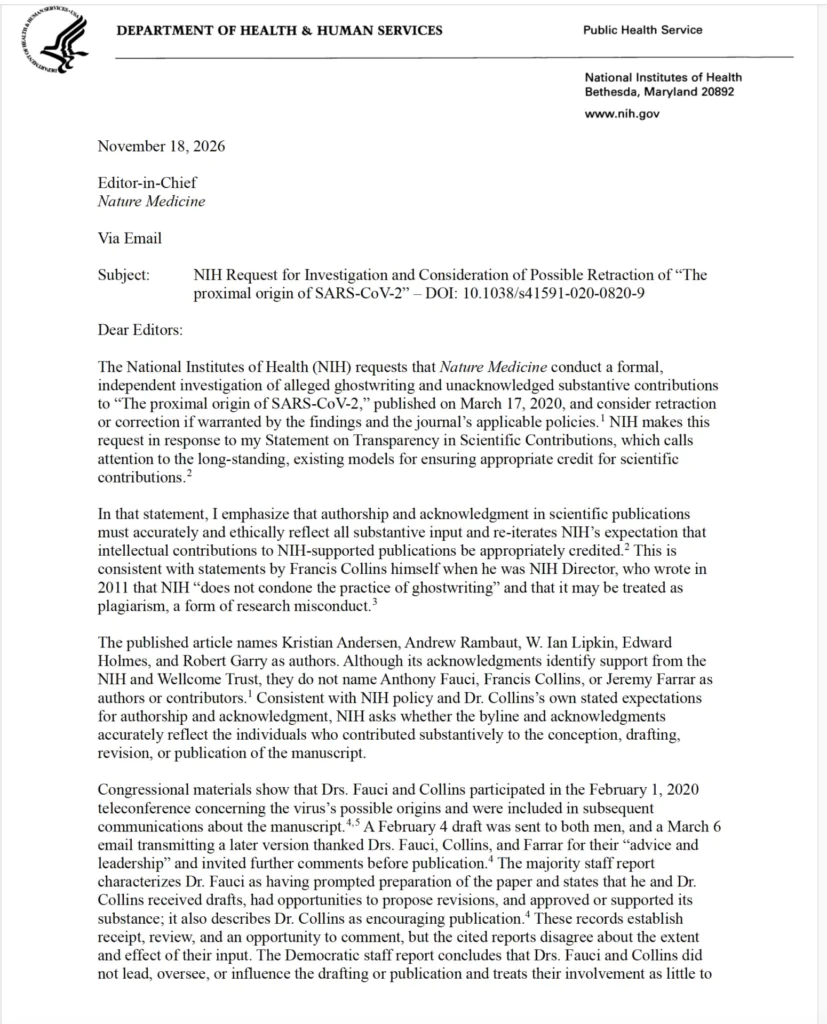
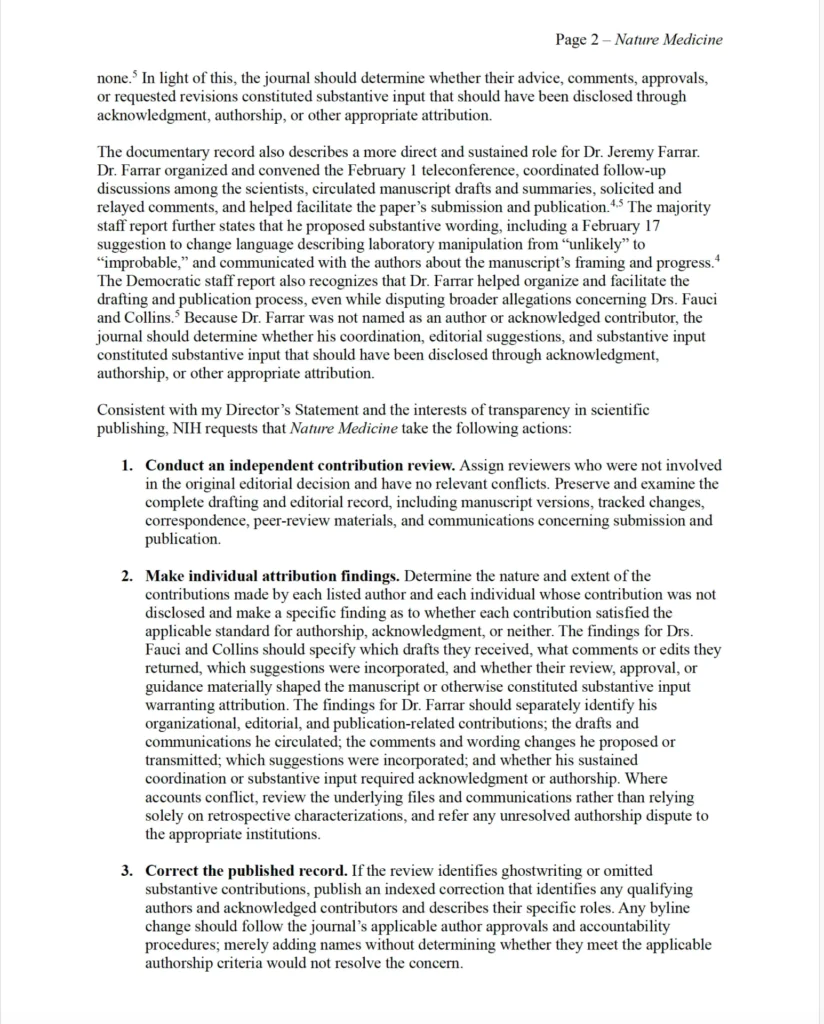
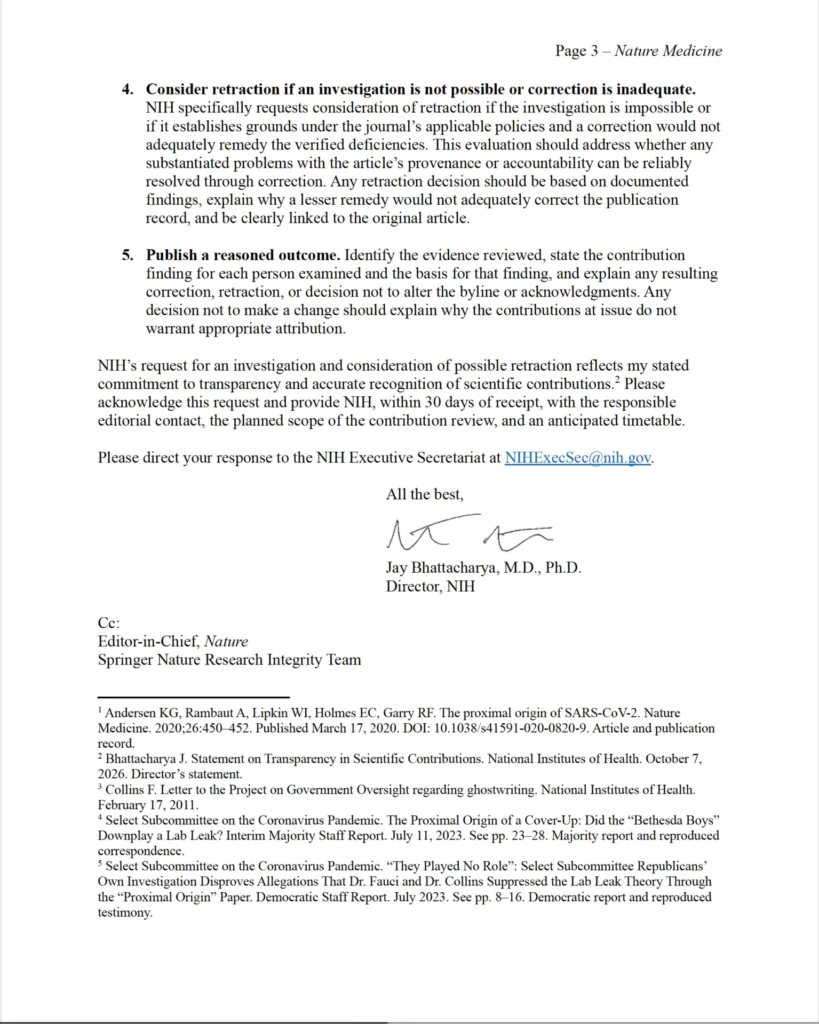
A couple of things. First, Podcast Jay is a flaming hypocrite. He spent years bemoaning government “censorship.” As Dorit Reiss pointed out in the comments, he was also a plaintiff in the case Murthy v. Missouri, which accused the Biden administration of pressuring social media companies to take his posts down. (The Supreme Court ruled against the plaintiffs, pointing out that they could not demonstrate that the Biden administration actually did that.) Yet, here he is, using the power of his office to intimidate editors of a journal to retract a paper he doesn’t like using specious reasoning and parroting lab leak conspiracy theorizing. It’s truly pathetic. After all, he wrote this letter on official NIH stationery, and the implicit threat if the editors don’t do what he wants them to do is obvious.
Same as it ever was. Only they can be the victims. They are the eternal victims. Even when they aren’t.