
[Note: After the death in the family last weekend, Dr. Gorski has decided to take one more week off from posting at SBM. He now plans to return to regular posting next week.]
In my clinical life as a pediatric hematologist specializing in bleeding and clotting disorders, I am essentially a “Bruise Detective.” My clinic is a constant parade of children with unexplained purple spots, mysterious bruises, and nosebleeds that won’t quit. My job is to determine if a child’s bruising is a benign badge of playground courage or the first sign of a serious bleeding disorder. I spend my days obsessing over the structural integrity of capillaries and the delicate balance of clotting factors.

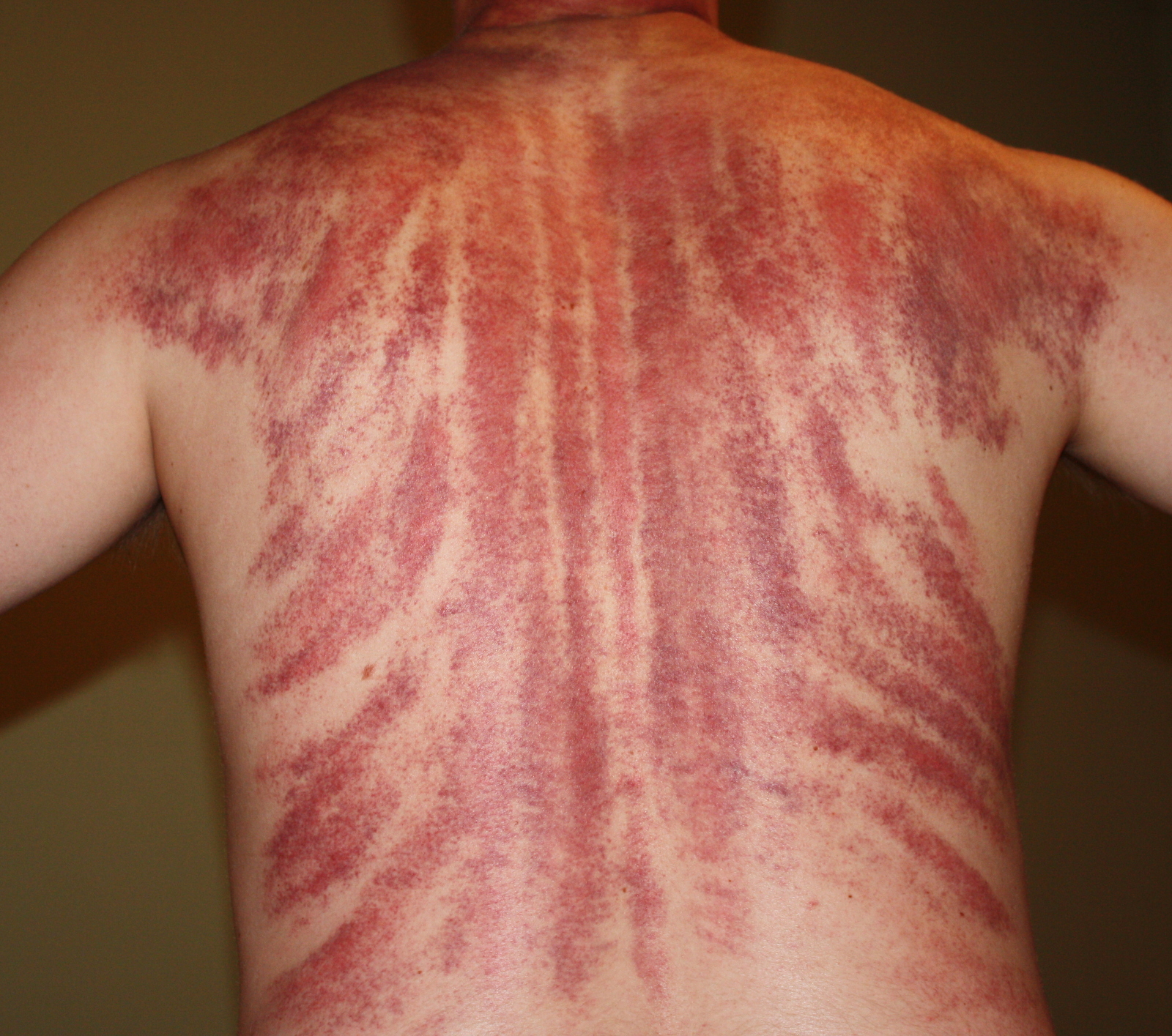
So, you can imagine my reaction to images like the one above. The skin is covered in confluent bruising (where individual bruises merge into one solid purple mass) and linear petechiae (tiny, pinhead-sized red dots appearing in long, angry streaks as if the patient had been attacked by a very small, very rhythmic tiger).
To the untrained eye, it looks like a high-velocity friction burn (or even strangulation when it occurs on the neck). The culprit, however, isn’t a traumatic accident; it is a “wellness” treatment gaining popularity at your local med spa. Gua Sha.
To a hematologist, seeing a patient pay a premium to have their capillaries intentionally shattered under the guise of “healing” is a bit like a firefighter watching someone pay an “arson consultant” to “detoxify” their living room with a blowtorch.
What is Gua Sha?
Gua (scraping) Sha (sand/redness) is a Traditional Chinese Medicine (TCM) practice that involves using a smooth-edged tool—traditionally jade, bone, or even a ceramic soup spoon—to apply pressurized strokes to lubricated skin. The goal is to produce sha: the bright red or purple spots that the medical community recognizes as localized trauma, but which TCM calls the release of “blood stasis” and “toxins.”
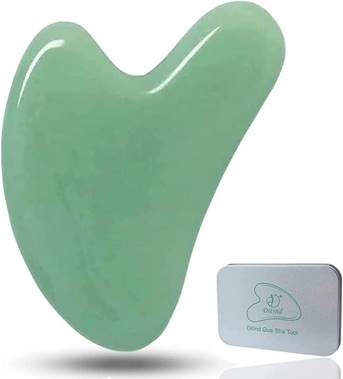
The tools have become more Instagram-friendly lately—often pink quartz carved into hearts—but the underlying premise remains rooted in pre-scientific vitalism. This relies heavily on the Argument from Antiquity—the logical fallacy that because a practice is old, it must be effective.
Examining the “Evidence”: The Fascia and Microcirculation
Proponents of Gua Sha often point to physiological “markers” to justify the practice. However, when viewed through the lens of SBM, these markers are more illustrative of “theatrical” physiology than clinical efficacy.
One popular theory is the “Squeeze Film” Lubrication Model proposed by Stecco et al. (2013), which suggests that mechanical pressure increases the flow of hyaluronic acid between fascial layers. Hyaluronic acid acts as a lubricant for these tissues. They make no mention, however, that aggressive scraping is superior to simple massage. More recently, a study by Wang et al. (2025) claimed that just 15 minutes of Gua Sha could “thin” the thoracolumbar fascia and thereby “reduce stiffness, improve mobility, and alleviate low back pain by releasing adhesions and restoring tissue glide”.
However, these studies supporting Gua Sha suffer from several critical flaws:
- The Anisotropy Artifact: Fascia is highly organized and collagen-rich. Its appearance on ultrasound changes drastically based on the angle of the probe. Research in PLOS One shows that a tilt of just 5 degrees can significantly alter thickness measurements. A “thinning” of 0.06 mm is well within the margin of error for probe angulation—it is more likely a measurement error than a biological breakthrough.
- The Microcirculation Gap: A frequently cited study in the Journal of Internal Medicine showed a fourfold increase in microcirculation at the treated site. But any localized trauma triggers vasodilation. The crucial questions remain: Microcirculation of what specific substances? In what concentrations? To what end? Claiming that an inflammatory response to injury is inherently therapeutic is a massive leap of faith.
A Watchman or a Driver of Illness?
In recent literature, such as Slater et al. (2024), researchers have proposed that the fascial system may act as a “watchman”—a highly innervated sensory organ that receives and processes information on whole-body health and inflammation.
This is an intriguing biological hypothesis, but it is being over-interpreted by practitioners and proponents of Gua Sha. Even if we concede that fascia acts as a “watchman” or a marker of systemic dysregulation, it does not necessarily follow that intervening on the fascia will modify the underlying disease in any meaningful way.
In medical science, a marker is not always a lever. If the “watchman” is screaming because there is a systemic inflammatory fire, “scraping” the watchman until he bruises does nothing to put out the fire. It is a confusion of cause and effect. We currently lack high-quality, blinded interventional studies proving that “fascial health” is a modifiable variable that improves objective disease outcomes. Without that evidence, recommending or performing Gua Sha based on fascial theory is like painting over a “Check Engine” light: the dashboard looks different, but the engine is still knocking.
When “Sha” Is Dangerous
While the “wellness” industry often assumes its customers are the “worried well,” my clinic is proof that unrecognized bleeding disorders are hiding in plain sight.
Von Willebrand Disease (VWD), an inheritable bleeding disorder, affects up to 1% of the population. Many people reach adulthood without a diagnosis, only realizing they have a problem after a surgical procedure (or, perhaps a particularly aggressive spa day).
Then there is Hereditary Hemorrhagic Telangiectasia (HHT). HHT is a genetic disorder where the normal “buffer” of capillaries between arteries and veins is missing, leading to fragile, direct connections (arteriovenous malformations) that are prone to rupture. It is estimated to affect 1 in 5,000 people, yet roughly 80% of those with HHT remain undiagnosed. These patients are essentially walking around with “vascular short-circuits” that are extremely vulnerable to mechanical trauma.
For these patients, the “vigorous scraping” of Gua Sha isn’t just a quirky wellness trend; it’s a recipe for massive hematomas or even skin necrosis. There is profound irony in a patient with a bleeding disorder seeking a “detoxifying” treatment that intentionally induces the very vascular trauma their body is genetically ill-equipped to handle.
Comparison to Cupping
Gua Sha is the “friction” cousin to cupping’s “suction”. Both share the same central fallacy: that inducing localized ecchymosis (bruising) is therapeutic. Both rely on the visual “theatrics” of the bruise to convince the patient that something “potent” has happened. In both cases, the “toxins” supposedly being released remain unidentified by any biochemical analysis. They are metaphorical toxins—a linguistic sleight of hand used to sell a physical injury.
Conclusion
As skeptics, we must challenge the idea that “ancient” equates to “effective.” Gua Sha celebrates tissue trauma as a sign of healing. While the nature of touch and the placebo effect may provide temporary symptomatic relief, we must be clear about the physiology: we are looking at ruptured capillaries and localized inflammation.
Before a patient visits a med spa for a “scraping” session, they should ask themselves why they are paying to undergo a treatment that, in any other context, would be classified as physical assault. As for me, I think I’ll keep my jade for jewelry and encourage my patients to keep their capillaries intact.