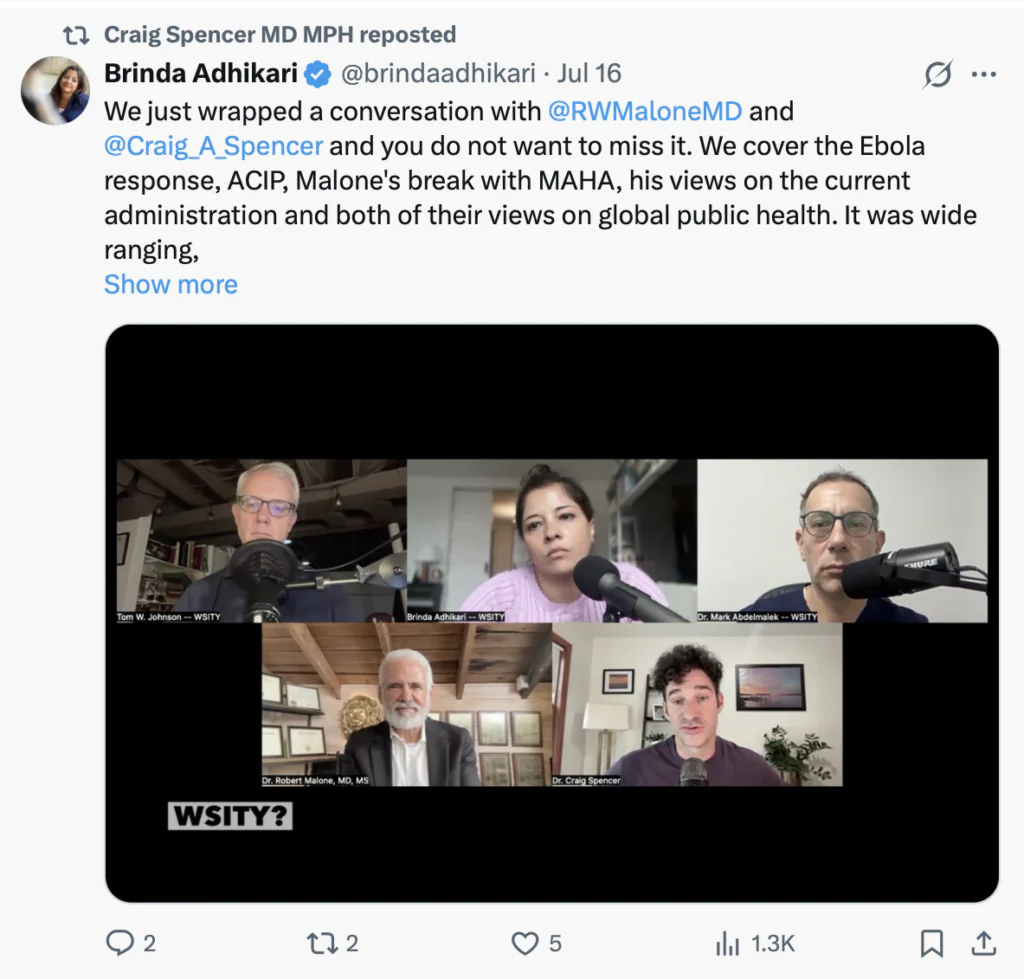


Three months ago, I wrote a post for SBM entitled MAHA and science-based public health: Can’t we all just get along? Regular readers, even if they never actually read that post, can probably predict my answer: No. At least, the answer is no as long as MAHA continues to embrace outright quackery, massive deregulation of medicine and drug approval, Lysenkoism 2.0, and antivax pseudoscience, nor should the science-based medical community try to “get along.” Indeed, ever since our current Secretary of Health and Human Services, Robert F. Kennedy, Jr., a rabid antivax activist going back to at least 2005, co-opted the slogan “make America healthy again” (MAHA) in order to make it his own after having suspended his Presidential campaign to bend the knee to Donald Trump in return for power, there have been colleagues and pundits telling us that “MAHA is more than just antivax” and that “MAHA has tapped into something real.” While the latter might be somewhat true, unfortunately you can’t separate MAHA from the antivaccine movement, nor can it be separated from the motley assortment of “health influencers,” quacks, antivaxxers, and grifters who see the movement as a vehicle that will let them profit selling supplements, unproven treatments (e.g., peptides), and “health freedom” to the masses.
Not that that keeps publications like The Atlantic and doctors like Dr. Craig Spencer from trying.

This week is another one of those “Dug the Dog” moments, where, as the fictional talking dog in the animated movie Up is easily distracted by a squirrel, I was immediately distracted from the topic that I had originally been planning on writing about by an article in The Atlantic by the aforementioned Dr. Spencer entitled, Public Health Needs MAHA, in which it is argued that the “field must swallow its pride and admit where the insurgent movement is right.” Just reading the headline, I imagined the sound of thousands of eyes belonging to science-based physicians, scientists, and public health experts all rolling at once before thousands of palms hit thousands of faces. As I started to look through this, I also realized that Dr. Spencer was one of the public health experts who had appeared on the panel that I had discussed when I concluded that science-based public health can’t really get along with MAHA. So here we go again.

Before I dive into the article, let me preempt the sorts of attacks that MAHA apologists usually launch whenever I write an article like this. I’m not saying that some of what MAHA claims to stand for—e.g., healthy food, more exercise, less environmental pollution, and the like—wouldn’t help to “make America healthy again,” although I might leave off the word “again,” given that it’s arguable that Americans back in the day were ever as healthy as MAHA stans try to claim. Let me put it more explicitly. MAHA is very much like a movement that this blog has been documenting since 2008, namely “complementary and alternative medicine” (CAM) or, as it’s now more commonly called, “integrative medicine,” in which seemingly uncontroversial, unobjectionable precepts (like healthy food, more exercise, adequate sleep, and listening to the patient) are blended with quackery and pseudoscience as though you can’t have the good evidence-based stuff without the quackery. The main difference between the two is that MAHA is far more explicitly a political movement than CAM/integrative medicine ever was, and the main similarity is that, like CAM, MAHA tries to hide its quackery under a seemingly unobjectionable set of ideas. Also, like CAM, MAHA often exaggerates what those unobjectionable health interventions can accomplish, the better to fuse them with the quackery. Just like CAM/integrative health, MAHA tries to make those unfamiliar with its history and the history of its precursor movements believe that we can’t accomplish all those good things with the overall MAHA umbrella.
With this background, you’ll soon see why Dr. Spencer is so misguided.
Scientists are close-minded and MAHA isn’t antivax?
I knew that Dr. Spencer’s argument was going to cause my blood pressure to rise right from the very first paragraph, which frames the issue as one of close-minded scientists not being open to what MAHA says, and he’s not very subtle about it at all:
Since Robert F. Kennedy Jr. took office, more than a year ago, I’ve been trying to understand the MAHA movement from the inside. I’ve sat in on MAHA Institute roundtables, roamed the conference halls of anti-vaccine gatherings, and talked with grassroots supporters across the country. They tell me their concerns about toxic chemicals and ultra-processed foods and the worrying rise in childhood chronic conditions. But when I share what I’m hearing with my colleagues in medicine and public health, many chide that engaging with MAHA is completely pointless. For them, the whole movement is nothing more than a subversive anti-vaccine, anti-science syndicate.
Let’s just say that, even if they might ignore some of the reasonable concerns that some in MAHA might have about public health and medicine in the US, Dr. Spencer’s colleagues in public health and medicine perceive MAHA far more clearly than he does and are far more accurate in their assessments. Just look at the leader of MAHA, the man who coined the slogan “MAHA”—actually, co-opted and claimed it—RFK Jr. As I’ve been documenting for over 20 years, he is an antivax ideologue who has demonized vaccines and, more recently, aligned himself with a veritable panoply of health influencers, grifters, and antivaxxers. Consistent with that, he has spent the last year and a half trying to take away your vaccines as he channels Trofim Lysenko in order to remake federal science into a combination of a venture capital source and a slush fund for patronage to reward supporters and punish opponents by placing scientific grant funding decisions in the hands of political operatives charged with making sure all science funding “aligns with administration priorities,” while de-emphasizing peer review as solely advisory. Meanwhile, RFK Jr., working for the Trump administration, has eagerly slashed the workforces of the NIH, CDC, and FDA, as he, for instance, stacked an FDA advisory committee with peptide advocates to vote to allow compounding pharmacies to sell unproven peptides, going against FDA scientists’ recommendations.
So, yeah, it’s not unreasonable of Dr. Spencer’s colleagues to view MAHA that way, not that it stops Dr. Pangloss Spencer from opining:
That assumption is wrong. MAHA is an opportunity, and one the public-health sector—academics, doctors, and leaders of advocacy groups—cannot afford to squander. Yes, MAHA’s anti-vax wing is very loud and litigious. But for many in the MAHA movement, their top issues lie elsewhere: environmental pollutants, the cost of health care, and a bone-deep conviction that health institutions have been captured by the industries they’re supposed to regulate. These are not fringe, unscientific concerns. They are concerns that millions of Americans have been angry about for decades, long before the MAHA label even existed. And they are concerns that many in public health share—if only they could see beyond that label, and make common cause.
I suppose that, if you view every crisis as an opportunity, you might make this sort of argument, but I find this line of reasoning less persuasive because this particular crisis was an entirely self-inflicted one that is ongoing. Reading the passage above, I was seized with the desire to retort, “You sweet summer child!” Why? Because public health has been concerned with environmental pollutants, healthy food, corporate malfeasance with respect to food and the environment, and the like, long before MAHA ever existed. Dr. Spencer basically concedes that the MAHA antivax wing is loud and litigious (because only an utter dolt would argue otherwise, given the evidence), but then pivots to try to convince you that it’s just a fringe minority in MAHA. It’s not. It’s central to MAHA. Just four months ago, the MAHA Institute, which, by the way, trademarked the terms “Make America Healthy Again” and “MAHA” (just look at the bottom of the MAHA Institute webpage if you don’t believe me) held a fear mongering “roundtable” called “Massive Epidemic of Vaccine Injuries” (MEVI), which, as I documented at the time, was full of longstanding antivax misinformation, bad science, pseudoscience, lies, and conspiracy theories, touted by a mix of new antivaxxers, useful idiots for the antivax movement, and old school antivaxxers like Del Bigtree, Mary Holland, Brian Hooker, Larry Palevsky, Toby Rogers, and Elizabeth Mumper. Even if Dr. Spencer is correct that most MAHA supporters are not antivax, the leadership of the MAHA movement most definitely is, and the two cannot be easily separated. After all, the main institute promoting MAHA, one closely allied with RFK Jr., is promoting some of the oldest and nastiest antivax propaganda there is.
Again, see the play? I agree that concerns about healthy food, lack of exercise, and environmental pollution are not fringe concerns. I agreed with that premise many times as I deconstructed the pseudoscience and quackery that is “integrated” into CAM/”integrative medicine.” I agree with that premise now. The problem is, MAHA is so loaded with antivax pseudoscience and conspiracy theories promoted by grifters and outright quackery (as you will see) that its misinformation and disinformation about health are the proverbial turd in the swimming pool. They contaminate the whole thing irrevocably.
Not to Dr. Spencer, apparently, who strives mightily to convince us that MAHA isn’t antivax:
That’s why a movement just two years old draws support from four in 10 Americans, according to polling from KFF. MAHA supporters cite the cost of health care as their top priority, followed by restricting chemical additives in food and limiting corporate influence in food policy. At the same time, nearly eight in 10 MAHA supporters consider long-established vaccines such as those for measles, mumps, rubella, and polio safe, and only 4 percent cite vaccines as their reason for supporting the movement. That disconnect alone shows that MAHA is not synonymous with a solely anti-vaccine constituency. It represents and reflects something far larger.
“Long-established vaccines” is doing some very heavy lifting here. Let’s just say that the wording is very careful, with two of the most established vaccines being carefully chosen. I would also argue that 80% of MAHA supporters believing that these vaccines are safe is actually a very low number! It gets worse as you read more of the conclusions of the KFF survey, where only half of respondents were “very confident” that these two vaccines are safe. The survey also discusses other vaccines:
MAHA supporters are among the groups least confident in the safety of the COVID-19 vaccine for children (31%). However, a majority of MAHA supporters are confident in the safety of the polio vaccines (78%) and MMR vaccines (77%), and to a lesser extent heptatitis B (60%) and the flu vaccine (55%).
These are very bad numbers for vaccine support, but in his effort to portray antivax views in MAHA as fringe, Dr. Pangloss Spencer cherry-picks the two best numbers. Here’s the chart from the KFF survey:
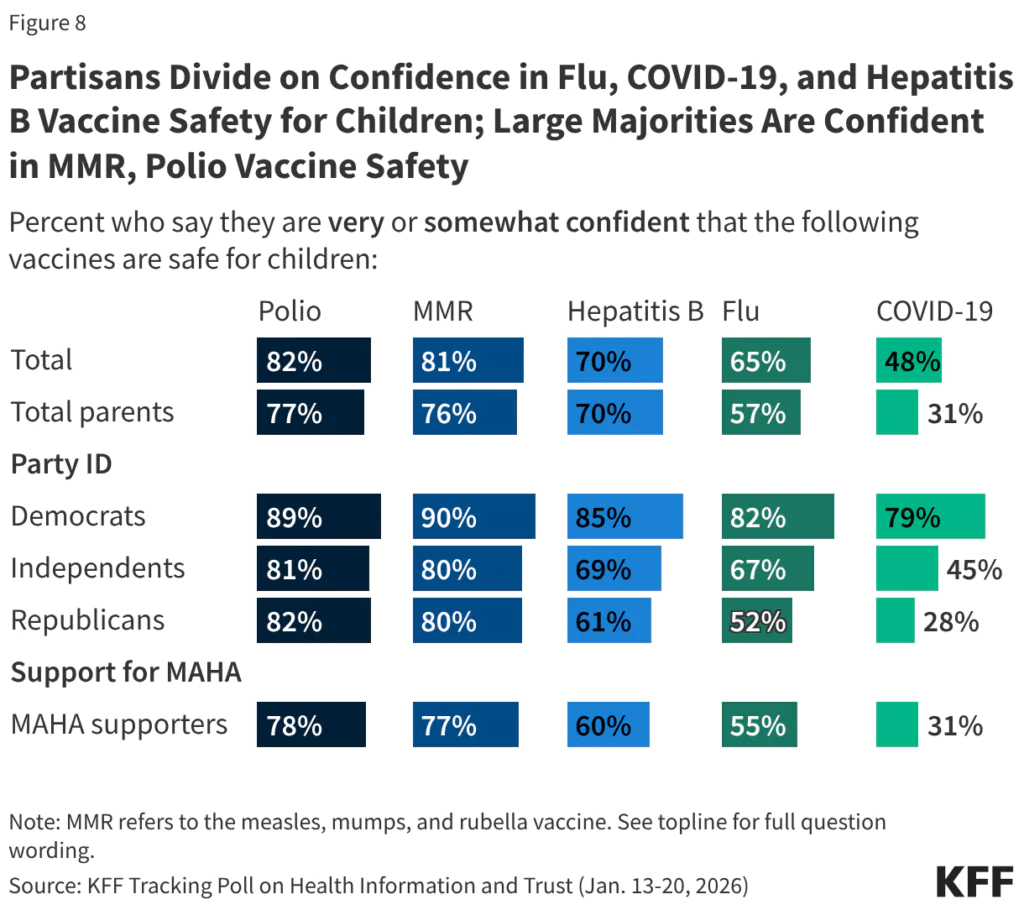
Again, these are horrendous numbers, given that high vaccine uptake is necessary for herd immunity. For measles, for instance, 80% uptake is nowhere near high enough to produce herd immunity. Uptake needs to be more like 90-95%. As a public health physician and scientist, you’d think that Dr. Spencer would know and acknowledge this. Also, as I like to say, antivax is a spectrum, not a black-and-white division, in which antivaxxers are opposed to all vaccines. While there certainly are “loud and proud” antivaxxers who believe all vaccines are harmful and that no one should be vaccinated, RFK Jr. being one of them even as he does his best to portray himself as “not antivax.”
The bottom line is that antivaxxers are one of the core constituencies of MAHA and always have been. They are foundational, and, indeed, they notice whenever RFK Jr. soft-pedals the quest to eliminate vaccines and to prove that they are responsible for autism and all manner of health problems and diseases; antivaxxers notice and are always none too pleased. Some are getting impatient because they don’t think that RFK Jr. has done enough to whittle down the vaccine schedule. Anyone who thinks that antivax can be separated from MAHA is living under a delusion. When Dr. Spencer opines that the number of MAHA supporters who believe that “core vaccines are safe “shows that MAHA is not synonymous with a solely anti-vaccine constituency, adding that it “represents and reflects something far larger,” he might have a germ of a point, but he’s ignoring how deeply entwined the antivax movement is with MAHA. It reminds me of the famous adage, “Other than that, how did you like the play, Mrs. Lincoln?” The allegedly “good” parts of MAHA are completely overshadowed and dominated by antivax, and you cannot separate them. Arguing otherwise shows a naïvété that I sometimes wish I had, but after 25 years of this, I cannot muster it.
At least MAHA “tries”?
One of the most bizarre and puzzling arguments made by Dr. Spencer in support of his belief that science-based public health should engage with MAHA in the way that he thinks we should comes in this passage:
When I sat down with Nancy Fuller, a lifelong Democrat and, more recently, a MAHA supporter, at a Christian coffeehouse in rural Ohio, she told me that what she likes about the movement is its willingness to try. Ever since her son was diagnosed with autism, decades ago, she has wondered whether environmental exposures or maybe vaccines were to blame, and she has spent years watching health institutions dismiss parents like her as ignorant or uninformed. In her view, public health steps up to the plate only when it already knows the outcome. Whether the issue is autism, AI, or something else, MAHA swings at anything and everything. That means more misses—and occasional hits—on issues everyone else had decided were too complicated, too compromised, or too politically inconvenient to touch. MAHA has never been shy about naming problems loudly and promising to take them on, even—and sometimes especially—when that means going after powerful corporations and other major institutions that others had learned to work around.”
Regarding the baseball analogy used to argue that MAHA’s big swings will lead to a lot of big misses, but also to the occasional hit, I agree with Melody Schreiber when she asked:
Notably, neither Nancy Fuller nor Dr. Spencer lists a single “big swing” by MAHA that led to a “big hit” in terms of improving public health. The baseball fan in me can’t help but point out that a team full of hitters who take “big swings” at everything is not likely to be that successful because its batters will strike out a lot and will probably not score a lot of runs other than the occasional solo home run. To carry this analogy nauseatingly forward, though, nowhere in Dr. Spencer’s article does he or Ms. Fuller give even a single example of a home run (or even “big hit”) from MAHA, even as he lists a lot of misses and strikeouts. Even the “successes” that MAHA advocates like to point to are not that impressive, ranging from the marginal (e.g., a couple of food dyes removed from products) to the harmful (trying to “make America Denmark” by whittling down our vaccine schedule to be the same as Denmark’s). After a year and a half in power, MAHA has no big successes to go with its big swings. At best, it has a couple of very modest successes, even if you accept its own definition of success.
Moreover, given that public health interventions affect huge populations, I would argue that, even if Ms. Fuller’s analogy were accurate, it’s actually a good thing that science-based public health doesn’t come up to the plate until it has a pretty good idea, based on scientific evidence, that what it is planning will be effective. I don’t want public health to be reckless, and apparently neither does Dr. Spencer. Why, then, does he defend MAHA and advocate engaging with it on its own terms? Also, why does he pivot to an even more head-scratchingly bizarre argument? Basically, Dr. Spencer concedes that, sure, MAHA is reckless and a lot of it is not based in science, but at least it’s not “too timid,” like science-based public health:
This is not a model public health should replicate wholesale. Many of MAHA’s swings have been genuinely reckless—pushing unproven and often dangerous wellness hacks, fabricating falsehoods about vaccine ingredients, and making claims that run counter to all credible evidence. But public health has been too cautious, setting the bar for evidence too high. On ultra-processed foods, environmental toxins, and drug prices, public health’s problem was rarely insufficient data. It was insufficient nerve.
So let me get this straight. Dr. Spencer acknowledges that much of what MAHA has tried to accomplish is “reckless,” pushes “unproven and often dangerous wellness hacks,” fabricates “falsehoods about vaccine ingredients” (if only that were all MAHA does in terms of spreading antivax disinformation!), and makes “claims that run counter to all credible evidence,” but nonetheless still thinks that science-based public health should engage with it? If public health sets the bar for evidence “too high,” then how low is acceptable, Dr. Spencer, because MAHA’s propagandistic “gold standard science” sets the evidence bar so low that it’s subterranean. Presumably, Dr. Spencer thinks there is a “golden mean” somewhere that is appropriate? What is it? How can we tell? The discussion of what the appropriate level of scientific evidence is to adopt a medical practice is, after all, a large part of the reason that this very blog was created over 18 years ago! I’d love to know.
Let’s say for the moment, however, that the problem with public health has been “insufficient nerve.” Public health cannot help but operate within the bounds that science and, yes, politics permit, because the interventions to promote public health often require government laws, policy, and action, thus making it impossible to separate them from politics and, in the US, partisan politics. That is one reason why I laugh derisively whenever I hear one of my colleagues opining that public health “should not be political” and want to ask: How, precisely, would you accomplish that?” Inevitably, the response tends to be that public health should “stay out of politics” and “be humble,” all while the subtext is that it should also accept the political framing that public health was too authoritarian during the pandemic and thus “lost the public’s trust”; in other words, the MAHA frame. Moreover, “nerve” in the service of quackery and pseudoscience, which is what MAHA appears to be, is not necessarily a good thing in medicine or public health!
But, again, in some fantastical past, public health used to be “bolder.” What does “bolder” mean? Here comes another head-scratchingly bizarre passage:
Public health was not always so timid. The field was born as a potent political force, arguing for safer workplaces, cleaner water, better housing. Somewhere along the way, it shrank into the background, with many of its leaders preferring to see themselves as a technical and technocratic enterprise that operates outside the fray. The problem with invisible shields is that nobody knows they’re there. When the field was forced out front, as it was during the coronavirus pandemic, many Americans experienced public health not as a shield, but as a scold—speaking in acronyms and waving data-filled reports. In COVID-19’s shadow, trust in essential health agencies including the National Institutes of Health and the Food and Drug Administration has dropped to all-time lows. Fewer than half of Americans now have confidence in the CDC to carry out its core responsibilities, a nearly 40 percent drop from the start of the pandemic.
My first reaction was stated pretty well by, again, Melody Schreiber:
Indeed. Left out of this narrative of how public health lost the trust of the populace, as is so often the case, is any mention of the powerful, well-funded, and relentless ideological forces that arrayed themselves against public health beginning as soon as the first public health official and organization had the temerity to suggest that maybe—just maybe—we should start taking collective action to try to protect people and mitigate COVID-19 spread and its worst effects. Indeed, our current HHS Secretary was among those forces himself, as were many of the sycophants, toadies, lackeys, and incompetents now in power at HHS agencies such as the CDC, NIH, and FDA. I noted very early in the pandemic how antivaxxers joined forces with pandemic minimizers and deniers in an unholy alliance. Two years later, antivaxxers were rejoicing at how distrust of COVID-19 vaccines was leading to distrust of all vaccines, and two years after that, the alliance of COVID-19 contrarians, antivaxxers, “health freedom” advocates, cranks, quacks, and grifters formed the basis of MAHA.
Now here’s the ironic thing. That link cited by Dr. Spencer about how public health had been a potent political force 100 years ago goes to a 2021 article by Ed Yong entitled How Public Health Took Part in Its Own Downfall. In the article, Yong argues that the reason public health became less of a potent force was:
By one telling, public health was a victim of its own success, its value shrouded by the complacency of good health. By a different account, the competing field of medicine actively suppressed public health, which threatened the financial model of treating illness in (insured) individuals. But these underdog narratives don’t capture the full story of how public health’s strength faded. In fact, “public health has actively participated in its own marginalization,” Daniel Goldberg, a historian of medicine at the University of Colorado, told me. As the 20th century progressed, the field moved away from the idea that social reforms were a necessary part of preventing disease and willingly silenced its own political voice. By swimming along with the changing currents of American ideology, it drowned many of the qualities that made it most effective.
In other words, Yong’s article basically argues for a much more more politically engaged public health effort that advocates for social reforms that address social determinants of health, which, unsurprisingly, MAHA all but ignores, paying mild lip service to it. For example, MAHA has done nothing to address food deserts or to ensure that everyone has adequate health insurance and access to care. It has basically ignored one of its supporters’ biggest concerns, with RFK Jr. basically shrugging his shoulders when President Trump issued an executive order entitled Promoting the National Defense by Ensuring an Adequate Supply of Elemental Phosphorus and Glyphosate-Based Herbicides.
But, but, but… conflicts of interest! Dr. Spencer spends a lot of time lamenting conflicts of interest in public health, singling out the American Academy of Pediatrics, which, one notes, is not primarily a public health organization but rather a professional society for pediatricians, with public health being only one important part of its mission:
One step to winning back the public’s trust would be a serious reassessment of the field’s financial relationships. The AAP’s own donor page lists at least 10 pharmaceutical companies as supporters, including six that manufacture vaccines the AAP recommends. And the six health organizations that sued HHS collectively received millions of dollars in donations from the pharmaceutical industry. Each organization maintains that these gifts are used to fund education or advocacy programming, not to influence policy recommendations or approvals.
In a low-trust environment, however, the appearance of a conflict is still bad, and RFK Jr. has made this entanglement the centerpiece of his critique. Public health’s refusal to acknowledge it has handed him an argument he doesn’t deserve to keep winning. If these societies can accept money from anyone, it’s worth asking why the donor pages are dominated by the very companies whose products they evaluate and recommend. If public health wants to save vaccine infrastructure in this country, it has to end these entanglements.
Dr. Spencer appears to have singled out the AAP because through legal action the AAP has thus far managed to stay the change in the CDC-recommended vaccine schedule that would “make America Denmark” by removing six vaccines it. It sued and won an initial ruling in federal court that RFK Jr.’s overhaul of the CDC Advisory Committee on Immunization Practices (ACIP) violated procedure, seemingly conflating AAP with the profession of public health at large, which the AAP is definitely not. Sure, I’ll agree with him that it would probably be better if the AAP weren’t so heavily funded by large pharmaceutical companies, but I’ll also add this retort. The AAP is far more transparent about its funding than MAHA has ever been. Moreover, the wellness industry is now a huge industry itself that is not shy about using its financial clout to advocate for its interests. Indeed, when it comes to MAHA, just as his boss Donald Trump is for MAGA, RFK Jr. is Grifter-in-Chief, with his antivax organization profiting mightily off of its efforts, with RFK Jr. and his ally, antivax attorney Aaron Siri, profiting off of their legal efforts against vaccines. Nary a peep is seen in Dr. Spencer’s article about this, and I haven’t even gotten to the supplement-industrial complex that is now highly influential among MAHA, which, it must be acknowledged, is rife with COIs.
Ironically, as you will see, Dr. Spencer appears to be arguing for the same thing, but in such a way that ignores the realities of today, even as he correctly lists the devastating actions that the Trump administration has inflicted on American public health, medicine, and biomedical research:
Now essentially out of power, the public-health community has been justifiably alarmed by what’s happened over the past year. The administration has prioritized politics over sound public-health policy in determining what’s approved by the FDA or what research is funded by the NIH. Severe staffing cuts at the CDC have weakened the response to health threats such as screwworm and Ebola. Many key leadership posts at the agency remain empty—the CDC has had a confirmed director for only 29 days of this administration. On immunizations, RFK Jr.’s Department of Health and Human Services altered the childhood-vaccine schedule in ways that reflect ideology, not epidemiology. It also overhauled the Advisory Committee on Immunization Practices, the expert body that has guided U.S. vaccine policy for decades. In response, the American Academy of Pediatrics distanced itself from the CDC and positioned itself as an independent, evidence-based guide for childhood vaccinations. More than two dozen states have already broken rank with the CDC’s recommendations. The result is a fracturing of vaccine guidance, a reflection of the fact that Americans no longer trust a single institutional voice on vaccines.
And you say that public health needs MAHA because…exactly…why? I mean, these are the sorts of actions by this administration that we at SBM have been bemoaning and analyzing ever since MAHA took control of all non-military federal medicine, public health, and biomedical research programs. The record that Dr. Spencer is describing sounds pretty horrendous to me. So, why does public health “need” MAHA?
Apparently this is why:
Public health must recognize there is opportunity in entropy. The path forward for the field is simple, but requires public health to do something it has been reluctant to do: Show up. Visibly. Politically, but not in a partisan way. There are fights that are strongly supported by both sides, including air quality in neighborhoods sharing zip codes with industrial facilities, lead and toxins in the water kids are drinking, and the poor quality of the food Americans eat and its clear negative impact on our health. These are issues where public health can stand next to communities, name what is harming them, and fight like it means something. What MAHA understands—imperfectly and sometimes dishonestly—is that people do trust institutions, but not because those institutions have good data. They trust them because they feel like those institutions are on their side.
Dr. Spencer, you sweet summer child!
Pretty much. I also can’t help but cite that KFF survey back at Dr. Spencer on another issue. The single most important issue MAHA voters care about for the midterms is not vaccines. It is not food dyes. It is not limiting pesticide use in agriculture. It is not food safety. It’s the cost of health care. Has MAHA done anything to decrease the cost and expand access to high-quality health care? Of course not! Quite the opposite!
I suppose that catastrophe, even self-inflicted catastrophe, can represent opportunity, but if you’re not going to address the actual cause of the catastrophe, it will be very difficult to seize that opportunity in a productive way. In the meantime, let’s imagine that public health does what Dr. Spencer says it should do and shows up, but “not in a partisan way.” What he is describing—advocating for measures to improve air quality, food quality, and the like—are not going to be perceived as nonpartisan! In fact, they sound pretty “woke” to me, and we know what this administration thinks of “woke.” (Also, the industries that would be impacted by such measures are all basically lined up with the Republican Party.)
All of this brings me around to wondering why Dr. Spencer, who is and emergency medicine doc and without a doubt a legit public health researcher at Brown University with an impressive track record (and I’m not saying this just because he graduated from the medical school where I currently serve as faculty, either), went down this particularly infuriating rabbit hole. This is, after all, a physician with an extensive history of volunteering for Doctors Without Borders, even contracting Ebola himself in 2014 while doing public health in Africa. This is also a doctor who in 2023 wrote an article for The Atlantic, How to Lose a Century of Progress in which he bemoaned rhetoric that was not called MAHA rhetoric at the time because MAHA in its current form had not yet come into existence, concluding:
Armed with a growing array of treatments and diagnostic tools, medicine has gotten much better at treating infections. But it can still do very little to stop a novel pandemic, and in March 2020, its ability to save lives from COVID wasn’t markedly better than during the 1918 influenza pandemic. America needs a robust field of public health to do what medicine cannot: keep people safe from emerging pathogens, environmental toxins, and gun violence. Medicine can treat people who are sick, but only public health can preserve their health in the first place.
And:
But Americans must make sure that public health keeps working, even if it remains unnoticed. It’s how you know that the cauliflower at the supermarket isn’t crawling with Cyclospora or that the water from your faucet won’t keep your children from seeing their first birthday. We’re lucky we haven’t had to think about it, but that doesn’t mean we can take it for granted.
As someone who lives near the epicenter of the Cyclospora outbreak that’s caused thousands in my state to experience what the press likes to call “explosive diarrhea,” I found that last paragraph prescient. Here’s the problem. MAHA is not about public health. It never has been. It’s about the individual über alles. In MAHA, germ theory and the genetic basis of health are largely denied, and health is viewed as a consequence of one’s virtue with respect to healthy behavior, and lack of health as a moral failing. That is the exact opposite of public health.
MAHA is popular today largely because its leaders have (mostly) successfully downplayed its antivax radicalism and its dedication to quackery, and that is why it can be attractive to people like Dr. Spencer. Such people see the damage MAHA is doing and understand its generally unscientific worldview. However, unfortunately, because they like the part of the MAHA message that is relatively uncontroversial about better food, more exercise, and the elimination of environmental pollutants, they swallow their apprehensions, hold their noses, and warily embrace MAHA, even to the point where someone like Dr. Spencer can even write that public health “needs” MAHA. This reminds me of 20 years ago, when ostensibly science-based physicians could recognize a lot of the quackery at the heart of CAM/”integrative medicine” but, because they liked the part of the CAM message that was relatively uncontroversial about better food, more exercise, and the elimination of environmental pollutants, were willing to hold their noses to block out the stench of all the naturopathy, chiropractic, acupuncture, reiki, and other nonsense in CAM, to focus on CAM message about the importance of diet and exercise, even sometimes saying that medicine “needs” CAM.
As the late Dr. Harriet Hall used to say about naturopathy, what is good about naturopathy is not unique to it, and what is unique to naturopathy is not good. Similarly, what is good about MAHA is far from unique to MAHA, and what is unique to MAHA is generally not good. (The analogy breaks down a bit because it’s not unique to MAHA. Lots of old time quacks have long promoted the same bullshit.) Unfortunately, in the case of CAM and MAHA, it is impossible to separate the two, and that is by design, as MAHA is basically now the political arm of CAM. These days, I doubt that approaches like the one advocated by Dr. Spencer will peel off enough MAHA supporters to make much of a difference, and certainly appearing on a podcast with real dishonest-to-goodness antivax cranks like Dr. Robert Malone won’t help.
But, then, what do I know? I’m just one of those perceived as a nasty, dismissive skeptic.