


“We may still pay a price for the pursuit of emergency use authorizations for covid-19 vaccines in children”
I got my start at SBM in May 2021 writing a response to a short opinion piece in the BMJ titled Covid vaccines for children should not get emergency use authorization. It was by Drs. Wesley Pegden, Vinay Prasad, and Stefan Baral and concluded that the vaccine should be unavailable to most children until it cleared arbitrary, time-consuming regulatory hurdles.
It claimed the vaccine’s benefit for children would be “relatively minor” and that “unlike adults, covid-19 vaccination is not addressing an emergency.” “We may still pay a price for the pursuit of emergency use authorizations for covid-19 vaccines in children,” it warned ominously.
The only facts in it were that the swine-flu vaccine caused Guillain-Barré syndrome in 1976 and that COVID was milder for children. However, the article omitted what mattered most and what I discussed at length in my article—the basic facts of how COVID had already hurt children the first year of the pandemic.
Nonetheless, despite being entirely fact-free, this article met the standards of the BMJ.
“Circulation of SARS-CoV-2 may in fact be desirable”
However, this was not the only or even the worst piece of fact-free, anti-vaccine drivel the BMJ published that month. Another opinion piece that also met the BMJ’s standard was titled Vaccinating children against SARS-CoV-2 by Drs. Jennie S Lavine, Ottar Bjornstad, and Rustom Antia. It also aged poorly.
I’ve not discussed these authors previously; however, I’ve discussed doctors like them many times before. None of them treated COVID patients, and their inexperience allowed them to speak about pediatric COVID with a sheltered casualness available only to the laptop class. Pediatricians who treated sick children never blew off what they saw as “typically mild.”
I’ve also discussed their ideas and techniques many times before. That’s what We Want Them Infected was all about, and the BMJ paper certainly wanted them infected.
It spoke as if the pandemic was ending in May 2021, and it too warned that vaccinating children could have dire consequences.
Unfortunately, as virus circulation decreases, the age of primary infection increases, and since age is directly associated with pathogenicity, vaccinating children would likely lead to lower infection rates but higher case fatality rates. Additionally, depending on the relative durations of immunity induced by vaccines and infection, and the rate of viral antigenic change, vaccinating children might increase the frequency of large seasonal epidemics, leading to overall increases in virus induced morbidity and mortality.
In their telling, vaccinating little Johnny might kill Granny, you know, based on the rate of viral antigenic change. The safer path for them both was to let Johnny get COVID, repeatedly.
They spoke about a “balanced decision” and came down firmly on the side of the virus:
Should childhood infection (and re-exposures in adults) continue to be typically mild, childhood vaccination will not be necessary to halt the pandemic. The marginal benefits should therefore be considered in the context of local healthcare resources, equitable distribution of vaccines globally, and a more nuanced understanding of the differences between vaccine and infection induced immunity.
Once most adults are vaccinated, circulation of SARS-CoV-2 may in fact be desirable, as it is likely to lead to primary infection early in life when disease is mild, followed by booster re-exposures throughout adulthood as transmission blocking immunity wanes but disease blocking immunity remains high. This would keep reinfections mild and immunity up to date.
We knew by May 2021, when these BMJ papers were published, that infections in younger people invariably spilled into older people. There was also preliminary evidence via an RCT (published later that month in the NEJM) that the COVID vaccine was safe and effective for adolescents. Neither of the BMJ papers mentioned these important results.
Instead of informing its readers, the BMJ paper did PR on behalf of the virus. It said that circulation of SARS-CoV-2 “may in fact be desirable,” followed by “booster re-exposures throughout adulthood to keep reinfections mild and immunity up to date.” Here we are, once again.
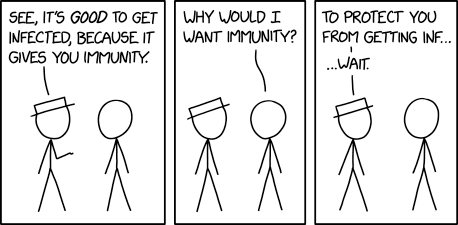
Source: xkcd comic
“COVID-19 vaccine strongly effective for children and adolescents amid delta and omicron”
The BMJ paper also made predictions. It spoke of “decreasing virus circulation” and speculated that “childhood vaccination will not be necessary to halt the pandemic.” It further presumed that “childhood infection (and re-exposures in adults) would continue to be typically mild.”
All of this turned out to be wrong, and this wasn’t some mere academic debate. The stakes were high.
The Delta and Omicron variants arrived immediately after these two BMJ papers were published, each variant spiking pediatric infections, hospitalizations, and deaths. Parents of deceased children predictably felt regret for skipping the vaccine, which unsurprisingly turned out to be very effective in preventing rare, but grave outcomes in children. Meanwhile, COVID infections failed to keep COVID infections mild. Today the headlines read: Repeat COVID infections tied to higher odds of new health conditions.
Oops.
Last week, Dr. David Gorski wrote an article titled Once again, The BMJ, Wittingly or Unwittingly, Reinforces an Antivax Narrative that discussed an “investigation” by the BMJ regarding a short delay in reporting a rare vaccine side effect. This side effect was nearly always temporary and mild, and it did not fundamentally change the risk-benefit equation for the vaccine. Nonetheless, the BMJ treated this perceived failure as a big scandal.
However, if the BMJ wants to once again revisit venerable institutions that misled the public in 2021, they should look inwards at the BMJ. Until they demonstrate the integrity to revisit their own dismal failures regarding literal life-and-death matters, there’s no reason to care about their opinions regarding issues less consequential than that, is there?