


A tale of the life cycle of a research publication that met an abrupt, but just, end.
Good research should aspire to answer a question. The question might be: Does a novel therapeutic regimen show promise in the treatment of cancer? This is the question the authors of a recently retracted paper want you to believe they were answering. What they were really asking is: Can we run a quick-and-dirty study, lacking in scientific rigor, that we can use to promote an entrepreneurial hypothesis?
This ill-conceived, poorly executed study purported to study the effectiveness of a combination of two anti-parasitic drugs: ivermectin and mebendazole for the treatment of cancer.
All of the authors of the study were associated with The Wellness Company, an online entity selling supplements and prescription medicines via telehealth providers. Among the products they sell is the precise combination of ivermectin and mebendazole used in their study. The study was initially displayed on their website and posted on non-peer-reviewed repositories. It was touted and amplified on social media.
Many observers recognized critical, if not fatal, flaws in the study. I wrote a critique on Science Based Medicine in May 2026.
The study was eventually accepted and published in the Journal Anticancer Research, followed shortly by an Expression of Concern issued by the publisher, in which the publisher expressed concerns about the ethics in the conduct of the study, as well as the validity of the data and the conclusions of the study.
Timeline:
April 7, 2026: “Real-World Clinical Outcomes of Ivermectin and Mebendazole in Cancer Patients: Results from a Prospective Observational Cohort” is published on Zenodo. Zenodo is an online open-access repository. Researchers can post a variety of research-related documents, including non-peer-reviewed papers and preprints. Even prior to peer review, the study was highlighted with great fanfare on The Wellness Company’s website and social media.
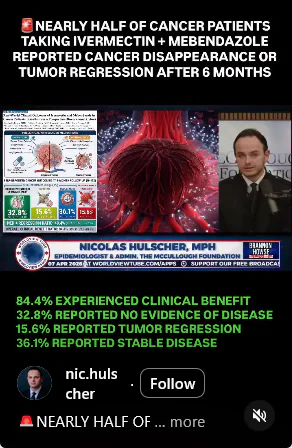
Screenshot from: https://www.instagram.com/reels/DW4QVMgkT7B/
April 8, 2026: A manuscript of the article was received by the journal Anticancer Research for peer review
April 20, 2026: After the first round of peer review, a revision was received from the authors.
April 24, 2026: Paper is accepted for publication.
May 27, 2026: Article is published by Anticancer Research.
June 1, 2026: Publisher issues an Expression of Concern
Notable on the above timeline is the speed with which the paper was peer-reviewed: Sixteen days from submission, to review, to revision, to re-review, to acceptance is remarkably swift. Kudos to the Journal and to the peer-reviewers for such an efficient process. In my many years as an author and as a peer-reviewer, I have never experienced such a quick turnaround.
Also notable was how quickly the Editors issued the Expression of Concern—only 4 days after publication. Per the editors: “Following publication, serious scientific concerns were raised by the international medical community regarding the verifiability and statistical reliability, and ethical oversight of the underlying dataset.” The influx of serious scientific concerns must have been swift, numerous, and persuasive.
I wrote a second SBM article describing the publication of the paper and subsequent Expression of Concern in context with the problems I discussed in my initial SBM article.
There were two main issues raised in the Expression of Concern: The first being the quality and validity of the data. The second was the ethical conduct and appropriate oversight for the study. I had expressed concerns about both of these issues in my previous SBM articles here and here.
The journal explained they were initiating a “…formal Post-Publication Data Integrity and Ethical Oversight Audit” during which the Editors intended to explore the validity of the data used in the paper’s analysis. They also planned to audit “… source-verified clinical records confirming the baseline cancer diagnoses of the 197 initial participants and the objective medical documentation supporting the reported anatomical regressions.” This was a curious request from the Editors and a difficult problem for the authors, given that the paper explicitly stated that the data came from patient-reported surveys collected by the authors, not from medical documents, a critical flaw in the study. Instead, the paper analyzed outcomes based on patient-reported tumor diagnosis, status, and regression without any review of the medical records.
The second concern was regarding ethical oversight of the research. Human research generally requires oversight by an Institutional Review Board (IRB), a committee convened to protect the interests of research subjects. In the April 7, 2026, Zenodo reprint (and the version published on the TWC website), the authors claim a dubious exception, deeming the project exempt from the need for IRB oversight on the grounds that the nature of this study was not human research, but rather “quality improvement”—a claim I discussed in detail here. On the same date, in their press release, they claim that “Because the research constitutes a public health surveillance activity the study did not constitute human research and does not require institutional review board review or exemption according to the Common Rule (45 CFR §46). We followed the reporting guideline for case series studies.”
In borderline cases, it is up to the investigators to seek the opinion of an IRB on whether or not their project is exempt. The Editors stated they would “… evaluate the mandatory Institutional Review Board (IRB) approval or exemption documentation…”
This was the state of affairs at the time of my second SBM article on this subject.
An update
There have been some significant subsequent events.
On September 1, 2026, the journal issued an Update to the Expression of Concern announcing a “change in scope” of the post-publication review and declaring the original audit “concluded.” Here is the updated Expression of Concern in full:
Regarding: Hulscher et al., “Real-world Clinical Outcomes of Ivermectin and Mebendazole in Cancer Patients: Results from a Prospective Observational Cohort,” Anticancer Research Vol. 46, No. 6, pp. 3243-3255, 2026 (DOI: 10.21873/anticanres.18194).
The Editorial Board of Anticancer Research issues this update to record a change in the scope of its post-publication review of the above article. The Expression of Concern (DOI: 10.21873/anticanres.18276) published on 9 June 2026 remains part of the published record and should be read together with this update; the original notice has not been altered or removed.
The audit described in the original notice is concluded. The Expression of Concern announced a Post-Publication Data Integrity and Ethical Oversight Audit directed to documentation of institutional review board approval or exemption, source verification of the participants’ baseline diagnoses, and medical documentation of the reported outcomes. Those requests have been withdrawn. The question of ethical oversight is not pursued and forms no part of the ongoing review. The Board draws no adverse inference from the non-production of any material and will not rely on these matters as grounds in the continuing review.
The continuing review concerns different matters. In the course of the review, and of the authors’ appeal against the course the journal proposed, specific questions have arisen concerning the design, analysis, and reporting of the study. They concern the construction and interpretation of the composite outcome reported as a Clinical Benefit Ratio and of the self-reported survey measure underlying it; the timing of baseline assessment relative to treatment exposure; the basis for the reported relationship between dose and adverse effects; the analysis presented in support of the representativeness of the follow-up sample; the composition of the dose-stratified analysis; and the treatment of participants without follow-up, and of concurrent conventional cancer therapy, in attributing the reported outcomes.
These questions have been put to the authors, who have been invited to respond to them. The continuing review is confined to them.
No allegation of fabrication, falsification, plagiarism, image manipulation, or other research misconduct is made against any author. The Board does not allege that any published count, denominator, percentage, confidence interval, or reported test statistic was arithmetically miscalculated.
The appeal is under active consideration. No final decision has been taken on whether the article should be corrected, retracted, or otherwise updated. Readers should continue to exercise caution in interpreting the article’s reported outcomes pending the conclusion of the review, which the journal will announce.
- Copyright © 2026 International Institute of Anticancer Research (Dr. George J. Delinasios), All rights reserved.
I found this announcement…confusing…at best. Remember, the initial Expression of Concern resulted from feedback that “serious scientific concerns were raised by the international medical community.” Based on these concerns, the Editors raised questions about whether or not the authors used sound methodology, and whether or not they performed their study in compliance with standards of protection of human research subjects, as well as in violation of the Journal’s own editorial policies.
Now the Editors announce that they have completed their audit. In the initial Expression of Concern, the Editors explicitly called out that: “This investigation will evaluate the mandatory Institutional Review Board (IRB) approval or exemption documentation…” In the Update, they announce: “The Board draws no adverse inference from the non-production of any material and will not rely on these matters as grounds in the continuing review.” This is not a completed audit—it is a retreat.
The Editors also announce that they will focus on different matters regarding the analyses and validity of conclusions. These are relevant and important concerns, but are rather subjective compared to those stated in the original Expression of Concern.
October 1, 2026: Retraction
Four months after the Expression of Concern, and one month after the Update, the Editors announced that the paper had been retracted. The retraction is based on the analysis, the terminology, and the conclusions used by the authors of the paper. These are the types of concerns that are often adjudicated in a rigorous peer review. In addition, an attempt to negotiate a “correction” with the authors failed.
Following post-publication review, independent expert assessments, and consideration of the authors’ appeal, responses, and proposed correction, the Editor of Anticancer Research retracts the above article because methodological and analytical problems undermine the reliability of its central clinical-benefit conclusions. …
The correction proposed by the authors would retain the clinical-benefit terminology, therapeutic-signal characterisation, and representativeness analysis with further qualifications. The missing clinical reference information cannot be reconstructed for the cohort from the available survey data. An adequate revision would require withdrawing, rather than qualifying, the principal clinical conclusions and supporting claims. It was therefore concluded that correction was insufficient.
I am pleased that this article has been retracted, for all the reasons explained in my two previous articles. I am disappointed that the issues raised in the initial Expression of Concern will remain unanswered and unresolved. Based on the Expression of Concern, there was credible apprehension that the authors submitted, and that Anticancer Research accepted, a paper that was in violation of its own Ethical Policies and Standards. The Editors have now retreated from the audit that would have explored these serious concerns. Were the 197 cancer patients who participated in this study afforded appropriate protections? Was participation truly voluntary? Were they given proper informed consent? Did they know that their survey answers would be published in a study? Were they able to withdraw from the study, and were they informed of such? Was their personal health information protected per statute? There may now be no public accounting of these questions. The Editors have provided no insight into why the serious questions enumerated in the initial Expression of Concern were abandoned without resolution.
A trail of retracted papers…
There are 12 authors listed on the paper. The first author is Nicolas Hulscher, MPH. A 10/12/26 search at Retraction Watch found he had 3 previous retracted articles. Co-author Peter McCullough, MD, MPH, is Chief Scientific Officer for the Wellness Company and the common denominator for much of their scientific productivity. A search in Retraction Watch on 10/12/26 found McCullough had six retractions (3 in common with Hulscher) and one Expression of Concern. Add one more retraction to each of their résumés.
The Wellness Company Responds
Wellness Company website acknowledges the retraction of the Anticancer Research article, followed by a recapitulation of the extravagant claims that got the article retracted.
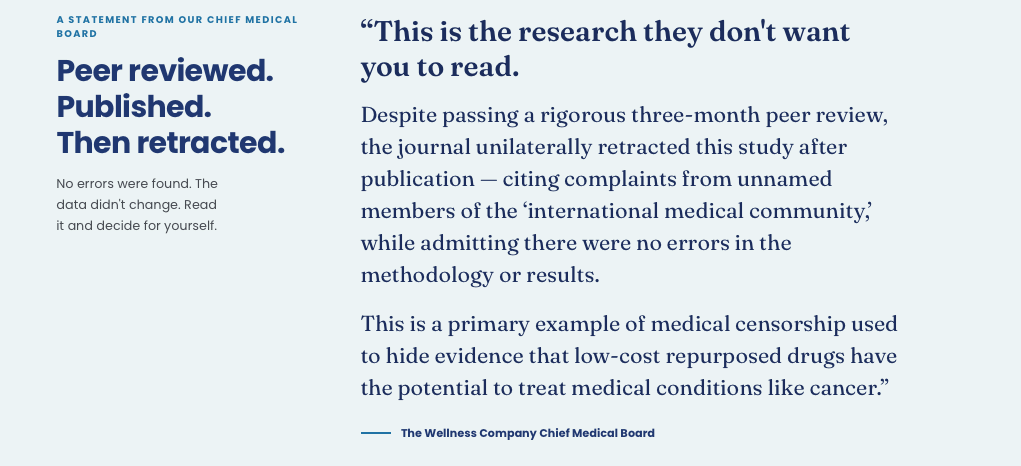
The Chief Medical Board statement claims that the paper passed a “rigorous three-month peer review.” The peer-review process actually took 16 days from submission to acceptance, based on the Journal’s metrics. They also claim that the journal “unilaterally” retracted the study. However, as clearly stated in the retraction notice, independent experts were consulted, and there was an attempt to negotiate with the authors to avoid the need for retraction. Ultimately, it was concluded that the correction offered by the authors was simply insufficient.
Unsurprisingly, TWC has spun this as censorship of “…evidence that low-cost repurposed drugs have the potential to treat medical conditions like cancer.”
Unfortunately, the sequence of events surrounding publication and retraction of this article gave TWC a lane to claim that this is persecution and censorship. The paper survived peer review. The initial Expression of Concern raised questions of data integrity, as well as whether or not the study was performed with adequate ethical oversight. The Editors backed away from these questions without resolution. Ultimately, the retraction was a veto of their own peer-review/editorial decision to accept the paper. This was, in my opinion, a justified action, but as much an indictment of their own process as it is of the quality of the paper.