


“One place where we had some success was Florida.”
Last year, I wrote a review of the book In Covids’ Wake, written by two Princeton political scientists, Stephen Macedo and Frances Lee. My article was titled A Review of “In Covid’s Wake”: According to Laptop Class Professors, the Heroes of the Pandemic Were Laptop Class Professors, and it discussed their chapter on the Great Barrington Declaration (GBD).
The chapter had many flaws. One of the biggest was that it mistook boasts for accomplishments. For example, Dr. Jay Bhattacharya bragged that he would have opened schools and would have protected the vulnerable, and Macedo and Lee believed him. In their world, “calling for” other people to do things on Fox News was a great accomplishment. It never occurred to them that they might have something to learn from those of us who worked in hospitals. That perspective didn’t matter to them at all.
I also noted that the authors of the GBD had a track record in Florida, which Macedo and Lee ignored. I wrote:
As those of us who operate in the real world know, there was a big difference between writing the words “open schools” or “protect the vulnerable” and actually accomplishing these tasks when COVID was swirling. In areas where the GBD had influence, they failed to accomplish a single thing they would have done. In October 2021, just after the Delta wave ravished the state, Dr. Kulldorf stated, “One place where we had some success was Florida.” Let’s examine their “success” there:
- They failed to protect “vulnerable” people: “Florida Leads Nation in Number of COVID-19 Deaths of Nursing Home Residents and Staff,” August 2021.
- They failed to protect “not vulnerable” people: “Child Covid Deaths More Than Doubled in Florida as Kids Returned to the Classroom,” September 2021.
- They failed to keep schools open: “School Closures Reported In Five Florida Counties; Districts ‘Drowning’ In COVID,” August 2021.
- They failed to protect educators: “15 Miami-Dade Public School Staff Members Die of COVID In Just 10 Days,” September 2021.
- They failed to achieve herd immunity: “Florida’s COVID Deaths Reach Nearly 6,000 in 2024,” January 2025.
Macedo and Lee were careful not to let this uncomfortable reality intrude into their fantasy of the GBD.
In my view, these real-world “successes” mattered infinitely more than all the amazing, wonderful things the GBD authors “would have” done.
“Is it your assertion that picking headlines of dead kids is a good way to evaluate a policy?”
Not everyone saw it that way, and I think exploring why helps explain how we got to this sad moment. One political science professor from Stanford’s Hoover Institution was unimpressed with my critique. They weighed in in the comments here and said:
I always find it odd that someone would claim to be too busy to read a book, but not so busy that they can write a review of the book they haven’t read.
I didn’t claim to be “too busy” to read the entirety of In Covid’s Wake. The professor just made that up. In reality, I said the chapter I read was so bad “I wasn’t going to waste my time reading further”, and I didn’t review the parts I hadn’t read.
The professor continued:
One potentially useful criticism for you: picking a state (Florida) at random and grabbing some headlines about various bad outcomes is not a good way to assess the influence of a policy. I recommend reading the book though, maybe you’ll want to apologize. Or maybe you’ll want to write a longer essay about what they got wrong. At any rate, it is good to read an argument before criticizing it! You might learn something too.
I didn’t pick Florida at random. The professor just made that up too. Even though it was right there in my article, my clueless critic had no idea that I picked Florida because Dr. Martin Kulldorf was right when he said, “One place where we had some success was Florida.” The most recent addition to their list of “successes” is an article titled Florida Ranks Last in Reading, Warns Nationwide Education Report.
My critic was unbothered by these headlines, however. They didn’t matter to him at all. The professor asked me an easy question:
Is it your assertion that picking headlines of dead kids is a good way to evaluate a policy?
My answer is yes. The news reports I shared weren’t false after all, nor were they random sob stories of tragic accidents. Rather, they revealed how the authors of the GBD failed to do anything they claim they “would have” done and the immense suffering that resulted. Now that 5 years have passed, I am unaware of any formal studies or analyses showing that Florida thrived while they helped run the show in the summer of 2021.
As such, headlines of dead children, especially when combined with headlines of dead seniors, dead teachers, and closed schools, aren’t just a “good way” to evaluate a policy—they are the only way to evaluate a policy. What matters more than reality itself? As SBM commentator Mike Stevens put it:
When someone says “One place we had success with implementing Policy X was Florida”, then it is entirely apposite (sic) to look at the outcome of Policy X in Florida, and if it has failed, to point that out.
He’s absolutely right, and it’s hard to imagine this being controversial. It’s not as if Florida would have been better off had only more unvaccinated people contracted COVID, as the GBD advocated right before the Delta variant ripped through the state.
The professor, however, disagreed:
I don’t think that the evidence provided—a series of very troubling newspaper headlines—could establish the policy as a failure or success.
Of course, that “policy” was We Want Them Infected, but according to this professor, a series of very troubling newspaper headlines are insufficient grounds to judge it as a failure or success. Incredible.
“A sixth measles-related death is reported in Pennsylvania”
I am writing about this particular professor not because they were exceptional, but rather because their open apathy was common and ordinary amongst sheltered, elite opinion makers. All the credulous podcasters and “liberal” book reviewers who fawned over Macedo and Lee’s pandemic fanfiction similarly revealed that what happened in the real world didn’t matter to them either. It’s no wonder they deliberately avoided frontline healthcare workers and anyone else who might puncture their fantasy bubble with a reality needle. The pandemic was just an intellectual parlor game for these pundits, something to be debated, not experienced.
They also didn’t grasp that Florida’s catastrophe contained a warning for us. As the Delta variant arrived in Florida, the authors of the GBD spread anti-vaccine misinformation and falsely reassured people the risk was gone.
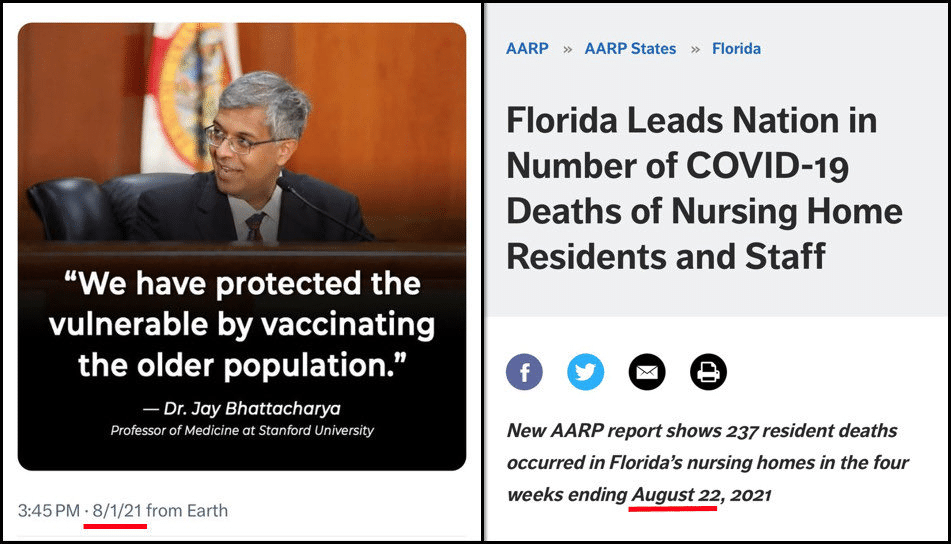
This had real-world consequences. As epidemiologist Dr. Jason Salemi put it in an article from October 2021 titled Florida Delta Wave Cases Plunge, Leaving Record Deaths in Its Wake:
An overwhelming majority of those deaths and hospitalizations could have been prevented through a combination of improved ability to get shots in arms, as well as those other mitigation strategies.
He was right, and the best predictor of the future performance is past performance. Those of us who paid attention back then aren’t the least bit surprised by what’s happening today. Even though the GBD authors are doing “their best“, COVID is still closing schools, and measles is killing unvaccinated Americans now that they have power.
No one can say the warning signs of MAHA’s malevolence and incompetence weren’t there. All anyone had to do was read the headlines and care about them. Sheltered laptop class professors didn’t care, however, and they didn’t hide their indifference: they were proud of it.