


Her recent breast surgery went perfectly. The tumor is out, margins are clear, and none of her scans show any cancer. So, she is understandably distraught when I begin to discuss the option of chemotherapy. “But I thought they got it all,” she says.
As a medical oncologist, I have had some version of this conversation hundreds of times, but it never gets easier. We call it adjuvant therapy — the medical practice of giving a person four to six months of chemotherapy after their cancer surgery, just in case. The underlying logic of adjuvant therapy rests on a single uncomfortable fact. Even when seemingly found early, a solid tumor may have already started to spread. The surgeons remove everything they can see in the operating room, but rogue cancer cells may already be growing in the liver, the lungs, bone, or brain. If those microscopic deposits survive and are allowed to multiply unchecked, they will eventually grow into incurable disease.
Adjuvant chemotherapy
The idea of giving someone chemotherapy after surgery to kill off remaining cancer cells seems obvious now, but it took a generation of trials to prove that it actually worked. Gianni Bonadonna’s group in Milan initiated a landmark clinical study in 1973 showing that chemotherapy given after breast surgery improves survival. Additional trials run by large cooperative groups in the United States validated and further refined this approach in breast cancer. Today, the benefit of adjuvant therapy has been proven across many of the most common types of cancer.
When meeting with a patient who just completed a “successful” surgery, simply asserting that there is a benefit to chemotherapy is insufficient. Patients demand more information when confronted with chemotherapy and its associated toxicities, both real and perceived. As such, oncologists must be prepared to quantify the benefit and risk whenever possible. For breast cancer, this need has led to the creation of online nomograms (or calculators) such as PREDICT. After inputting information about the specific patient and their cancer, the odds of benefiting from chemotherapy are returned. The estimated benefit is reported in absolute terms and takes into account competing (non-cancer-related) causes of death. The most informative graphic displays the predicted outcomes of 100 patients who choose adjuvant therapy.
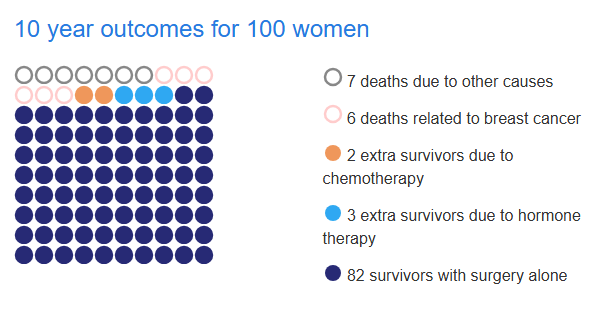
Who will benefit?
The truth that follows from these types of calculations is humbling. Even in high-risk patients, the majority of treated patients will not benefit from adjuvant chemotherapy. Instead, it is more likely that a patient falls into one of the two groups that were never going to benefit from the therapy. The first group was already cured by surgery, so the chemotherapy adds only toxicity. The second group will relapse even after receiving months of chemotherapy. A minority of treated patients sit in the narrow therapeutic band that oncologists are aiming for; those are the patients that are cured by the addition of chemotherapy.
Oncologists regularly recommend months of adjuvant chemotherapy when it benefits 5% of our patients. In that scenario, we must treat 20 patients with chemotherapy to save one life. For some patients, that number is too small to consider chemotherapy. Perhaps they recognize that they are much more likely to be among the 19 patients who endured toxic therapy with little to show for it. Meanwhile, others are eager for any chance to improve their odds no matter how small. I often try to put myself in their shoes, but it is difficult… these are high-stakes decisions made under duress.
Transforming the adjuvant landscape
The most encouraging development in adjuvant therapy is that we keep getting better at assigning the odds. Compared to ten years ago, I often feel like I have the luxury of seeing an extra poker card before placing our bet. Tests such as Oncotype DX use genomic information from the surgically removed tumor and identify more women who can confidently forego chemotherapy. Newer genomic blood tests can now detect early evidence of residual cancer cells before they are visible on scans and may one day transform the adjuvant decision. This newer generation of tools is one of the great success stories in oncology — using better information to limit our therapies to those predicted to truly benefit.
Once you recognize the general shape of the “adjuvant” decision, you find it nearly everywhere. Consider the statin prescribed to a person who has never had a stroke or a heart attack. Most of the patients on these medications are never going to have one of those events. Furthermore, even in patients whose cholesterol numbers improve, some will still go on to have a stroke or heart attack. Only a minority are “saved” by the intervention, and we do not know who in advance. Consider the antihypertensive, the bisphosphonate, the screening colonoscopy. Each is an imposition — a pill, a needle, a procedure, a cost — accepted in exchange for a chance at extending life. Structurally, each of these decisions is identical to deciding whether to order additional therapy after surgery.
What would medicine look like if we consistently treated each “ordinary” prescription and intervention with the same rigor reserved for adjuvant chemotherapy?
Making the right choice
Oncologists, arguably more than any other specialty, practice a radical form of shared decision-making. This is accomplished by focusing on a few habits, none of them unique, but most uncommon once you leave the cancer clinic. We demand absolute numbers over relative ones. Chemotherapy that cuts relative disease risk by 18% sounds more impressive than the reality that it only helps 3 out of 100 patients. We acknowledge that in most instances, people taking a preventative medication will ultimately not benefit from it. We never confuse the recommendation, even when pulled from the guidelines, with the decision. We review the cost of every intervention, not just its promise. A good oncologist is also constantly looking for chances to do less rather than more when the numbers support it.
So, I think back to the woman whose surgery went well as we sit down to discuss the pros and cons of adjuvant chemotherapy. We spend most of our time focusing on her values and her priorities. I offer a recommendation, but in truth, the most important thing I bring is an honest assessment of the numerical odds. The precision of those numbers stands in stark contrast to the uncertainty that awaits her. Next comes the most important part of my job… I trust her to make the “right” choice.
Most choices in life, even the mundane ones, are a variation of the “adjuvant therapy” decision — staking certain costs today against an uncertain tomorrow. Choose wisely… just in case.