


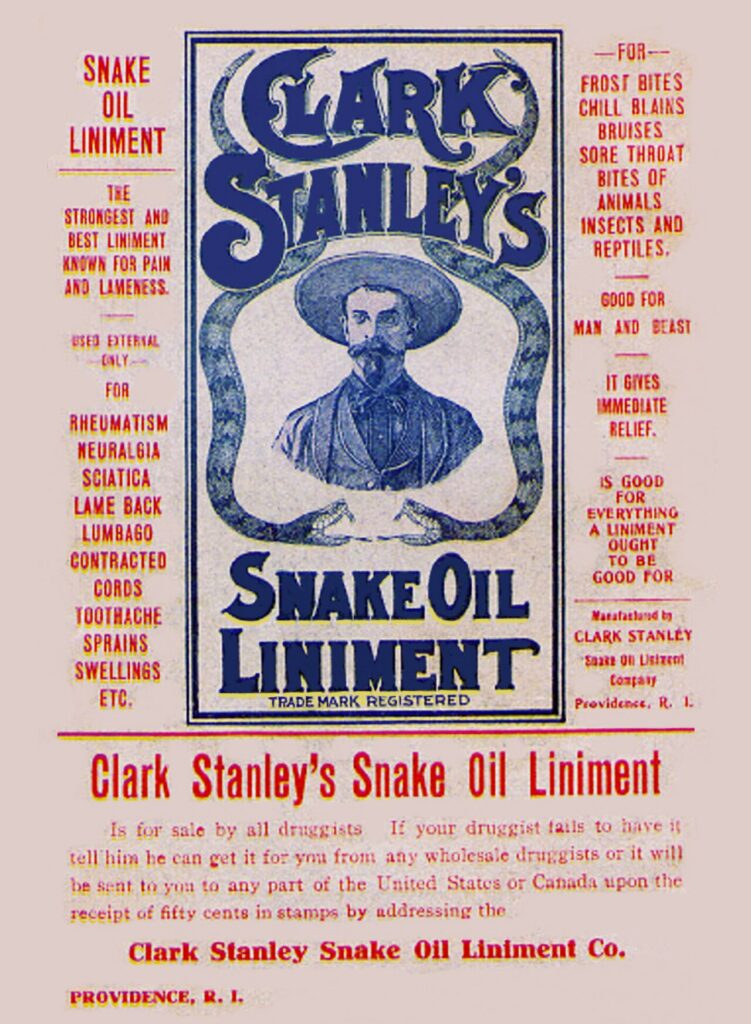
Clark Stanley’s Snake Oil Liniment promised relief from rheumatism, neuralgia, sciatica, sprains, toothache, and frostbite. When federal investigators finally tested it, they found mineral oil, fat, red pepper, and turpentine. The snake oil contained no snake.
“Snake oil” became shorthand for dubious health products and the people who sell them, but its origin story nicely illustrates why drug regulation exists. Stanley sold his liniment for years before the Pure Food and Drugs Act of 1906 gave federal investigators the right to test products like it. The Act was modest: what was in the bottle had to match the label. It took another decade for Stanley’s Snake oil to actually get tested, and that’s when the link to health fraud was established. Requiring proof of safety before product marketing came later, in 1938, after Elixir Sulfanilamide killed more than 100 people. The requirement for proof of efficacy before marketing didn’t appear until 1962, after the thalidomide disaster.
I’m not suggesting that peptides are the modern equivalent of snake oil. The parallel is the regulatory challenge: when what is claimed on the label may not be what is in the bottle, and when claims of efficacy go well beyond the evidence, we risk going back to the problems that led to the drug regulation framework in place today.
FDA Advisory Committee Backs Peptides for Pharmacies to Compound
There is nothing inherent to a peptide that makes it safe or effective.“Peptide” describes a type of molecule: a chain of amino acids. It is not a special regulatory category of medicine. Peptides can be powerful drugs – think of how insulin completely transformed Type 1 diabetes. But with insulin, its safety, effectiveness, dosing and manufacturing have been established over time through research and regulatory review. Semaglutide (Ozempic) was subject to a robust research agenda before approval in 2017. Other peptides, such those promoted on social media, may have little or no convincing clinical evidence to support them. The relevant question isn’t whether something is a peptide. It’s whether that particular peptide has been shown to be a safe and effective drug for the specific use being claimed.
This is why the outcome of an FDA committee deserves scrutiny. This past July, the FDA’s Pharmacy Compounding Advisory Committee (PCAC) recommended adding six of seven nominated peptides to the “503A” bulks list which are a list of substances pharmacies may use to compound drugs for individual patients. It made this recommendation contrary to the FDA staff’s own advice, whose briefing documents raised significant concerns about the limited safety and effectiveness evidence.
Section 503A allows drug products compounded by licensed pharmacists or physicians, when its conditions are met, to be exempt from FDA premarket approval, current good manufacturing practice (GMP) requirements, and certain labelling requirements. Compounding has an important role in pharmacy practice in meeting individual patient needs, such as when a patient requires a dosage form that isn’t commercially available, or is allergic to a specific ingredient. But the Bulks List also creates a pathway for compounding with substances that are not components of FDA-approved drugs. That creates the possibility that peptides, that have never been approved as drugs, could nevertheless become legally available in compounded products.
The PCAC’s vote is advisory; the FDA still has to decide. But the FDA generally follows the advice of its committees. And even if FDA ultimately adds these peptides to the Bulks List, that would not make the peptides FDA-approved drugs, nor would it mean FDA had determined that compounded products containing them were safe and effective. It would make the bulk substances eligible for use in compounding under section 503A (subject to that section’s other requirements). Importantly, these compounded products would not undergo the FDA premarket approval process applicable to approved drugs.
The Evidence Base
BPC-157 is the best-known of the peptides in the group assessed. What does the evidence for that drug look like? FDA’s reviewers assessed it for one use, ulcerative colitis. They found a single small trial, available only as a meeting abstract, and determined this was inadequate to support either efficacy or safety claims. They found no human studies using the subcutaneous, oral, nasal, or topical routes of delivery. Much of the rest of the research is in rodents or other animals, where dose-response relationships and the direct relevance remain unclear and unproven.
You wouldn’t know this from the marketing and hype. FDA documented clinics and compounding pharmacies promoting BPC-157 for many conditions, including gut disorders, tendon and ligament injury, and bone healing. These other indications were not reviewed due to a lack of evidence. It is the same gap as the snake oil example above: claims running ahead of the evidence.
What’s in the vial?
A compounded injectable is only as good as the chemicals you start with and the sterile process you use, and that process can fail. In 2019, FDA warned compounders about glutathione powder from one distributor after patients had reactions consistent with endotoxin exposure. FDA testing subsequently found excessive levels of bacterial endotoxin in samples of the powder. Earlier this year, the FDA linked at least 30 adverse events to IV glutathione made from dietary supplement grade ingredient (not appropriate for injectable drug use), leading to recalls. The lesson isn’t that compounding is inherently unsafe. It’s that the quality of the starting material is critical, especially when a product is going to be injected.
FDA’s reviewers noted concerning gaps in data with BPC-157. For the free base form, most publicly available certificates of analysis reported only purity, with nothing demonstrating control of impurities. For the acetate form, the certificates submitted with the nominations lacked results for specified impurities, aggregates, bioburden, and bacterial endotoxins. The reviewers concluded both forms were not well characterized, and flagged a potential immunogenicity risk for injected peptides, noting that no study had formally examined it. These are gaps in documentation and study, and not evidence of contamination. But their absence should be concerning to consumers who should expect ingredients are of high quality.
The FDA examined its own adverse event database and found three reports involving BPC-157, noting it could not tell whether the product was responsible in any of them. That sounds reassuring, until you read document notes: compounders operating under 503A generally do not report adverse events to FDA, so the agency may never hear of a problem unless a patient or clinician files a report on their own. FDA also could not determine whether pharmacies are currently compounding BPC-157 at all, or many people are using it.
Will harms from BPC-157 be detected? The glutathione problems were caught, but only after patients were hospitalized. In 2019 reactions were reported as beginning within minutes of infusion, and were traced to a single supplier. Problems with a more gradual onset, such as antibody formation that gradually blunts a drug’s effect or neutralizes the body’s own peptide, will be much harder to link to a product, and patients and clinicians may never make the connection. That’s my concern and not an established fact, but it’s why I’m not comfortable accepting a small number of adverse event reports as evidence of safety. The human studies of BPC-157 were small and short, and long-term information is missing. The risk may be small. But the system is not in a position to tell us, even if use grows.
Waiting for the FDA
Where all this goes next depends on the FDA. A final decision on the committee’s recommendation is pending.
Does BPC-157 “work”? Despite the popularity, there is no clear evidence that it works, for what, at what dose, or if it can be used safely over time. None of this shows that BPC-157 is harmful, and it may turn out to help in some conditions. But the challenge with BPC-157 and the other peptides under review is that the usual premarket processes that actually answer these questions don’t apply to compounded products. The 1906 law was about label accuracy. Safety had to be demonstrated from 1938, and effectiveness from 1962. Those requirements exist for a reason.
If you or someone you know has a possible adverse event linked to a compounded product, like a peptide, please report it to FDA’s MedWatch program. Under current rules, a report may be the only way the FDA collects this information.