


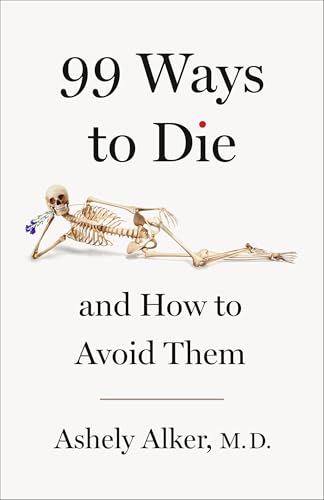
Ashley Alker’s 99 Ways to Die and How to Avoid Them covers everything: infections, heart disease, animal attacks, poison, car crashes, murder, warfare. The title suggests you’re getting a ranked guide to mortality avoidance, but what you get is a curated tour through causes of death Alker finds worth explaining. The book is part medical history, part mechanism explanation, and part workplace memoir. If you’re looking for a framework to prioritize your actual health risks, this isn’t it. If you want to understand the range of ways people die, told by someone who’s spent her career trying to stop people from dying, you’ll find this book engaging and educational.
Alker writes for a curious audience. She’s an emergency medicine physician “on a mission to improve public health.” She doesn’t oversimplify in this book – you’ll encounter technical explanations, vaccine mechanisms, disease transmission pathways, and important historical context. Some entries are longer and more detailed than others. Some include anecdotes and stories from her medical practice, others don’t. But she trusts that readers can handle complexity without getting lost. For a science-curious person, like the SBM reader, this is probably right up your alley. Alker explains things clearly, includes detail where it matters, often with humor, and moves on.
Alker describes her book as “an exploration of, and map to avoiding the ninety-nine most terrifying, interesting, and unfortunate ways to die.” She’s honest about her selections from the start. Cancer, the second-leading cause of death, doesn’t get an entry. Volcanoes do. Her editorial choices trade likelihood in favor of readability. The book isn’t a guide to reducing your actual risk. Rather, this is an education in the range range of ways people can die, chosen based on what Alker finds is medically interesting or historically instructive. You’ll finish it understanding more about disease mechanisms and medical history than you did before. And you will get tips on avoidance, where they exist. While I remain unafraid of volcanoes, I am now terrified of the Australian box jellyfish, and how it can kill a swimmer before they can reach the shore.
The book seems well-researched and based on my own (but limited) expertise, accurate. Regrettably, there are no references or citations to back up her statements, or to lead the interested reader to more detail. Where her advice differs from accepted guidance, she appears to acknowledge it. For example, on bat exposure, she is far more cautious than CDC recommendations, which she acknowledges. She advises immediate rabies treatment if you find a bat in the home, even if you’ve never knowingly contacted it. The CDC recommend capturing it for rabies testing, and consultation with a public health expert about post-exposure prophylaxis. This raised some concern if there is other guidance she gives that might differ from guidelines. Without references, you’re left on your own.
I appreciated Alker’s global health perspective. She’s worked in settings where access to any health care is difficult. It makes her understandably frustrated with “vaccine privilege” as she calls it, that has “created opportunities for malignant misinformation and sometimes willful ignorance”. She’s genuinely thoughtful about social determinants of health and health disparities. She explains why you might be at higher risk than someone else, and why access to prevention matters. This is an nuance other health books may lack, tending to to focus on the worried well and “optimization”, regardless of evidence or cost.
Conclusion: An entertaining read
99 Ways to Die doesn’t offer you a checklist to reduce your risk of dying. But it’s a smart book about disease, medicine, and social factors that can determine who lives and dies. If you’re interested in how diseases actually work (both common and exotic), why Alker finds certain ways of dying worth explaining, and what emergency medicine looks like from the inside, you’ll find this engaging. For readers of this blog, people who want science communication that doesn’t talk down, that acknowledges social determinants of health, and that trusts you to handle complexity, you’ll likely enjoy reading it.
Disclosure: I was provided a free copy of the book by Wunderkind PR without conditions.